Episode Transcript
[00:00:03] Speaker A: Hear the Sasquatch howling in the night Paranormal beings come out to play.
Feel that chill upon your neck but do not fear when the rugaloo bikes because we'll follow you into the dark.
We'll follow you into the dark into the Dark contains subject matter and language that may be unsuitable for younger listeners. Listener discretion is advised.
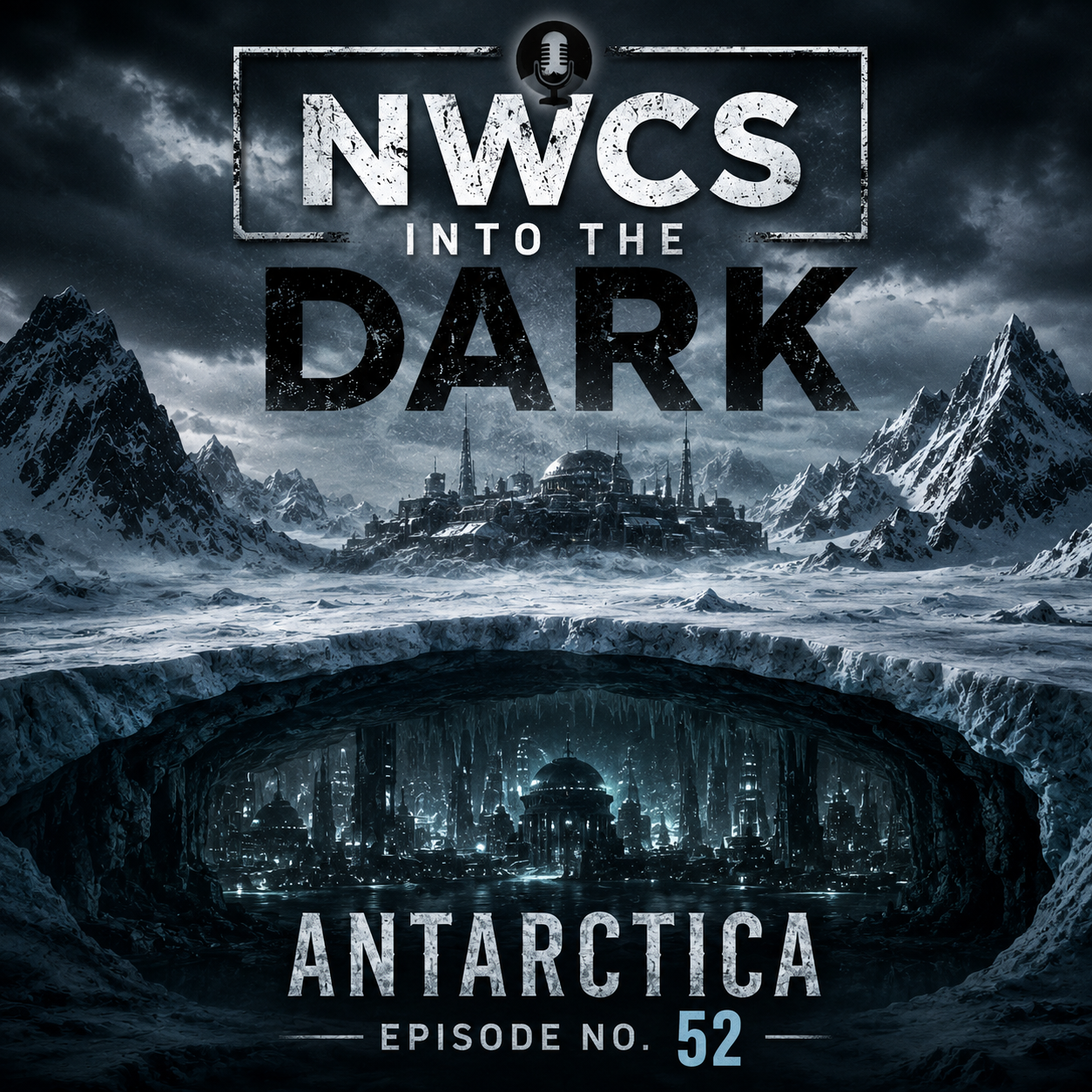
[00:00:50] Speaker B: Beneath the frozen crown of silence at the bottom of the world lies a land few have ever seen, and even fewer truly understand.
Antarctica, a continent of ice isolation and extremes, remains Earth's last true frontier.
It's a place where the sun disappears for months, the wind screams with ancient fury, and the very landscape seems determined to keep its secrets beneath a layer of ice.
On the surface, it's the domain of scientists and explorers, a land governed not by nations, but by treaty, dedicated to peace and discovery.
But deeper down, both beneath the ice and within, the stories passed through decades of speculation.
Antarctica becomes something else entirely.
It becomes a mirror to our fears, a beacon to the curious, and a vault of the unknown.
There are whispers of Nazi strongholds carved into the mountains of ice, tales of pyramids rising from the snow, their geometry too precise, too ancient to be natural.
Satellite images have revealed structures that defy explanation, zones that vanish from the maps and magnetic anomalies powerful enough to disrupt navigation.
Some say there's entrances to the hollow earth here. Others believe something was found and then hidden beneath Lake Havastas ancient waters.
Tonight, we head south, far, far south to the land of endless night and unbroken ice, where science meets silence, and myth wears a parka. NWCS delving deep into the secrets of the Antarctic.
[00:02:47] Speaker A: Hello, greetings and welcome to NWCS into the Dark podcast. This is Antarctica. What an amazing intro by Danny.
[00:02:56] Speaker C: That was fabulous.
[00:02:58] Speaker D: Bit chilly, Danny.
[00:03:00] Speaker A: Antarctica, what you got for us?
[00:03:01] Speaker D: No introduction.
[00:03:02] Speaker A: Oh. In the studio this evening, we've got Tab Ahoy. We've got Rob.
[00:03:08] Speaker E: Ciao.
[00:03:09] Speaker C: That's better. That's better than the last one.
[00:03:10] Speaker E: Ciao, bella.
[00:03:11] Speaker A: And Danny.
[00:03:14] Speaker D: Oh, yeah.
[00:03:16] Speaker C: And Scott.
[00:03:17] Speaker D: Scotty, you know, we still got to work on that intro thing for you. I think we need to sort that out a little bit more.
[00:03:27] Speaker C: Howdy, y'.
[00:03:27] Speaker A: All.
[00:03:30] Speaker C: All right, how about just say hi?
[00:03:32] Speaker D: Yeah, let's.
That's my baby boy. All right.
[00:03:36] Speaker A: That's my baby boy.
[00:03:38] Speaker E: That's my baby boy.
[00:03:39] Speaker A: All right, what do you got for us, Antarctica?
[00:03:42] Speaker D: Nothing. Nothing new.
[00:03:43] Speaker A: We're not going to waste our time with that.
[00:03:45] Speaker C: There's nothing new. We there. We're boring.
[00:03:48] Speaker E: I got a new drink.
[00:03:49] Speaker D: I do. I do have something new.
[00:03:51] Speaker C: I quenched my Thirst.
[00:03:52] Speaker A: Rob's got a new drink.
[00:03:54] Speaker E: Danny's got something new. What do you got new?
[00:03:58] Speaker D: I found a new drone that I'm going to get that will help do some investigatory work.
[00:04:05] Speaker C: What kind of drone is that?
[00:04:06] Speaker A: Fascinating. That's interesting.
[00:04:08] Speaker D: Yeah. And it's mostly just to carry the camera that I want to get, but.
Yeah. Yeah. Insta. Insta360 has put out some pretty cool cameras lately.
[00:04:18] Speaker E: Oh yeah? Yeah, I had one. I had an Insta360 briefly for writing. I had it on my motorcycle.
[00:04:25] Speaker D: Oh, yeah, yeah, yeah, yeah.
[00:04:27] Speaker E: But it. Just for that. What? Why? The purpose of what I was using it for was not. Not good. I just wanted it. Camera full time and it.
[00:04:37] Speaker D: Yeah.
[00:04:37] Speaker E: Battery and I. I hope they've improved on the battery and all that length and all that.
[00:04:43] Speaker A: I guess I have.
I've got something new.
[00:04:46] Speaker D: Yeah.
[00:04:46] Speaker A: Rainier has now come out with glass bottles.
So instead of drinking Rainier cans.
[00:04:53] Speaker D: That's not.
[00:04:54] Speaker A: It's a thing. Look.
[00:04:55] Speaker D: Glass bottles.
[00:04:55] Speaker A: That's horrible.
[00:04:56] Speaker D: That's horrible.
[00:04:57] Speaker A: It's amazing.
[00:04:57] Speaker C: And the mountain is about to pop,
[00:04:59] Speaker D: so I hear when I think. When I think Rainier, I don't think glass bottle. That's silly.
[00:05:04] Speaker E: Wait a minute. Didn't they have the, the. Didn't they have in the bottles before? Didn't they have the legs running?
[00:05:10] Speaker A: Yes, but they haven't had them in glass bottles in forever.
[00:05:13] Speaker E: Okay, so they have.
[00:05:16] Speaker D: What's next, hams in a bottle too? Is that. What.
[00:05:18] Speaker A: Why are you comparing Rainier to hams?
[00:05:20] Speaker D: Well, I'm just saying if you think about, you know, those beers. Are those beers?
[00:05:25] Speaker A: What do you mean by that?
[00:05:26] Speaker D: Those beers, those.
[00:05:28] Speaker A: Those beers. What do you mean by beers?
[00:05:30] Speaker D: You know, you know, you know, those beers.
[00:05:33] Speaker A: I hardly think you put Rainier in the same category as hams.
[00:05:38] Speaker D: I do. There's actually a bar in Portland that serves beer only in cans. And, and they have Rainier. They have hams. I can't remember the name of it. I don't even know if it's still open, but.
[00:05:48] Speaker A: Pbr.
[00:05:49] Speaker D: Yeah. That's good stuff. Some natty ice, you know, nice. Get yourself some good natty ice.
[00:05:54] Speaker A: But anyway, Antarctica, what do you got for us, Danny?
[00:05:57] Speaker D: Antarctica. Okay, well, you know, this is an interesting topic because it's one of those places that seems, for some reason not clear to me prior to today is shrouded in mystery for some reason. And so kind of thinking this through, the question is, why? So a little bit of history on Antarctica. It's Earth's most southern continent.
It's a vast and remote expansive site of land or ice and rock. So ice and rock all around. Surrounded by the Southern Ocean, covers nearly 5.5 million square miles and holds 90% of the planet's fresh water.
90% of the world's fresh water, yes.
[00:06:43] Speaker E: 90.
[00:06:45] Speaker A: Fascinating.
[00:06:46] Speaker D: Ice, rather.
[00:06:47] Speaker A: Sorry, that's interesting.
[00:06:49] Speaker D: And remains one of the most extreme environments on Earth, with temperatures plunging well below 100, negative 100 degrees Fahrenheit, and wind speeds that can strip flesh, apparently.
We'll talk about that later.
There are no permanent residents there, only rotating teams of international scientists and researchers who operate under the Antarctic Treaty System, which is another interesting point.
And it designates the land for peaceful and cooperative scientific pursuits only. There are no other things that happen there. So it is home to massive glaciers.
[00:07:28] Speaker A: Everything that happens there has to be peaceful.
[00:07:30] Speaker D: It has to. It's very explicitly said peaceful and cooperative scientific pursuits. This was a treaty that was put in place.
I think it was ratified in 90 or 61. 1961.
But it's home to.
[00:07:45] Speaker A: So when they're at their little bases, their little base camps and stuff.
[00:07:50] Speaker D: Yep.
[00:07:50] Speaker A: Do you think they. They drink?
[00:07:52] Speaker D: Probably not. I don't know if they can. What would that do to you in the cold? I don't know.
[00:07:57] Speaker A: So there's no fights. They never get in fights. Everything's just always getting fights.
[00:08:00] Speaker D: Yeah. Yeah.
It's home to massive glaciers, subglacial lakes and towering ice shelves. Antarctica is apparently. It plays a critical role in. In the global climate and sea levels.
There's impact there. And I believe that some of the research that they do. So it makes it one of the most scientifically significant regions on the planet. But if you start to think about a bit, you know, what, What? Again, why does it seem so shrouded in mystery? Right. It has a scientific reputation and some darker other things that people have reported after having been either there close by or shared stories.
Throughout the centuries, Antarctica has stirred the imagination of explorers, conspiracy theorists and storytellers alike. From ancient pyramids, formations underneath hidden underneath magnetic anomalies, to chilling legends of Nazi bases and entrances to Hollow Earth. We actually talked about that once before. The Hollow Earth thing, I think.
[00:09:03] Speaker A: I think that was Tab's episode.
[00:09:05] Speaker D: Yeah.
Not Middle Earth, we figured that out. But Hollow Middle. It wasn't about Gandalf, apparently.
The continent, though, is overall steeped in mystery.
It's inaccessibility and harsh. Harshness only fuel this speculation, of course. And I have some show and tell for you guys later to see your thoughts. But some that are Rob Love show and tell. Yeah.
Some things are rooted in truth, others in shadow or lore. So but either way Antarctica has this, this again, strange, dark and mysterious behind it.
Creepy place. Just again some of those shared stories and over time. So what do you guys think? What do you guys have on Antarctica? Why is Antarctica mysterious?
[00:09:51] Speaker A: I think just the inability, the. The inability to access it. I think anytime that you have something that is off limits, so to speak. Oh yeah, it's going to be ripe for conspiracy theory. It's a human nature who can go there or get there and then, and then you don't have permission to go.
Right. You know, it's like any place you can't go there's. It's just going to be ripe with conspiracy theories for sure.
[00:10:17] Speaker E: Maybe they should send a submarine down there.
[00:10:20] Speaker D: I hear that they use too soon. There's rumors that people use submarines to access portal doors miles underneath the land. Apparently some of these structures are reported to go deep below the ice and the land on the surface and that submarines are used to access some of these points.
[00:10:40] Speaker C: And some of these mountain ranges, they look like pyramids. There's some images of some perfectly triangular or square. These mountain ranges that look like pyramids.
[00:10:50] Speaker D: Yeah.
[00:10:51] Speaker E: All kinds of different creatures that we don't know about under there too.
[00:10:56] Speaker D: Yeah. There's been some fairly new discoveries, I believe of different creatures not having been seen before. But you know, one thing that's. Take all of the conspiracy theories aside, just thinking about the way the world has behaved over the last, let's say couple hundred years in that range. You know, we've had some big wars of course, all around the world. We've had two world wars and then many skirmishes all around different countries and so forth and so. But what blows my mind is that there is this steadfast, long held agreement in place not to bend no battle. It's a shared space.
There's been no challenge to take this land and claim that land in totality as it is right now. There are at least that I'm aware of seven countries that have claims on that land. Argentina, Australia, Chile, France, New Zealand, Norway and the United Kingdom.
[00:11:57] Speaker A: I think that's, I think that's pronounced Chile.
[00:12:01] Speaker D: Oh, excuse me, Chile.
[00:12:03] Speaker B: Chile.
[00:12:05] Speaker D: And they have territories on these lands. And maybe these folks aren't known necessarily for battling other than maybe the United Kingdom. But it's surprising that no one's. And it seems like it's a place that's resource rich. If I understand right, a lot of oil there, crude oil. Things like that. There's minerals, there's. There are things there that people would normally fight over but hasn't happened to my knowledge.
[00:12:30] Speaker A: Well, because there's a treaty in place and it's called the, the Antarctic Treaty of 1959, which doesn't allow them to do mining.
It prohibits any sort of military activity. Mineral mining, nuclear testing only peaceful scientific research.
[00:12:48] Speaker C: Yeah, only until there's a shortage of any of those.
[00:12:51] Speaker A: And there's obviously certain areas that are restricted, completely off limits. It's like. Yeah, I guess my question is. So they have this Antarctic Treaty signed by over 50 countries. What's stopping just normal person from flying over there, jumping out and checking stuff out? You just can't do it.
[00:13:08] Speaker E: Dying.
[00:13:08] Speaker A: You can't do it.
[00:13:09] Speaker C: No, not without authorization.
[00:13:12] Speaker D: It takes, it takes work to get there. Like you. It's not easy. I don't know that the average everyday citizen has, you know, maybe some of these.
[00:13:22] Speaker C: Just wait for the news update. I'll be covering that.
[00:13:25] Speaker D: Yeah, okay, good, good. But fascinating. It does blow my mind that, that that treaty has not been violated for some reason that we know of as, as, as other places in the world. Right. We hold, you know, maybe there's a treaty or just kind of the normal, you know, day to day, I guess, of not going to conquer other lands around the world for some.
[00:13:50] Speaker A: So you had mentioned the possibility of a Nazi base. I think that's been debunked. I think that they've done a lot of research that indicates that that was never really true, that there was never really a Nazi base.
[00:14:01] Speaker D: I heard that they were trying, but it never got lifted off the ground.
And, and that was a. It was a target, but it never got operational.
But yeah, yeah, it's like anything, I guess, and see if you know how to. How do you dig in, find out whether or not this was true? I don't know. They protect that land very, very well, but.
[00:14:22] Speaker C: Yeah, well, some would say they made it as far as Argentina.
[00:14:25] Speaker D: Yes, sure, I've heard that. Which is not far. Actually, I think one of the jump points to get there by, you know, closest land point is the southernmost tip of Chile. If I can.
[00:14:38] Speaker A: He said tip.
Speaking of jump locations, are you familiar with the Operation High Jump?
[00:14:45] Speaker D: Yeah, I've heard a little bit about that, but. Tell me more.
[00:14:47] Speaker A: Well, it was an operation from 1946 to 1947 which involved the US Navy. And it was a specific mission entitled Operation high jump involving 4,700 men.
And its purpose, or so they say was to officially test Cold weather equipment, but conspiracy theorist claims that it was a military confrontation with unknown entities.
[00:15:13] Speaker D: Interesting.
[00:15:14] Speaker A: Like, it was a battle of aliens in 1946 in the Antarctica.
Why would you send 4700 Navy personnel there?
[00:15:23] Speaker D: Yeah. To test.
[00:15:25] Speaker A: To test cold weather equipment.
Makes no sense.
[00:15:29] Speaker D: Yeah. And why would you need to test it to those extremes?
[00:15:32] Speaker A: Like, you know, like, it seems like you can get away with, like, three guys.
Yeah. Three guys go down there, like.
[00:15:38] Speaker D: Yeah.
[00:15:39] Speaker A: Damn, it's cold. This equipment's not working. We're out.
[00:15:43] Speaker D: It's like testing your tires in a. In a. On a rainy, wet. You know, turn on the freeway. That doesn't. It's probably not the right thing, the right time or place to test them,
[00:15:53] Speaker A: I guess, but I think we might need to call medical for Rob.
[00:15:57] Speaker C: We're losing Rob.
[00:15:58] Speaker D: He's having a little. Little moment.
[00:15:59] Speaker A: It's. It's.
[00:16:00] Speaker D: There is a section that is unclaimed there. Apparently this was because of. It was a section of the. The land that the. The continent, rather, that did not get claimed before the treaty was in place. They call it Marie Bird Land. It's the. Apparently the last unclaimed place on Earth. If you think about it, It's. It's not claimed by any. Or owned by any country because of this treaty. Again, odd for humans to not try and lay claim to those kind of. Kind of spaces, but it's situated between the Ross Ice Shelf and Ellsworth Land on the western side of Antarctica.
[00:16:39] Speaker C: Well, how about if I just claim it? I'm claiming it right now.
[00:16:43] Speaker A: I think. I think Trump actually. I think Trump actually recently renamed it Antarctic America.
Antarctic America.
He's already. He's already claimed it.
[00:16:55] Speaker D: Yeah. Apparently no other country claimed this, though, before 1961. It's 620,000 square miles of land and is again, the last unclaimed place of land on. On the Earth.
[00:17:07] Speaker C: Unusable land. You can't do anything with it.
[00:17:10] Speaker D: Is it. Maybe you can do everything with it.
[00:17:12] Speaker E: Yeah.
[00:17:14] Speaker A: You could do a pretty cool ice bar,
[00:17:18] Speaker C: ice motel, hotel.
[00:17:20] Speaker D: That would. That would be a thing.
I'm gonna do a show and tell for you guys.
[00:17:25] Speaker A: Rob's interested.
[00:17:26] Speaker E: Yeah.
[00:17:27] Speaker D: Yeah.
[00:17:27] Speaker A: Well, look at Danny's fancy Google Earth image going there.
[00:17:32] Speaker E: Nice. Nice.
[00:17:34] Speaker D: So this is Google Earth, right? This is.
You can see here, Chile.
It's a little wonky. And how it's oriented. I don't know how to spin it the other way, but nonetheless, this is South America, Right?
[00:17:46] Speaker E: Right.
[00:17:47] Speaker D: You can zoom in here and you can kind of get. And drop some, you know, Maybe drop a little dude over here somewhere to see what's going on. Let's see what's going on at Vina del Mar and Chile along the coast. Right. We've zoomed in. We can see pictures and I mean, you can see people's houses and all kinds of good stuff there. But again, if you zoom out, come back out and head over to Antarctica, which again, is not far from this space. Sorry, it's going slow on laggy. Yeah, I think it doesn't like being in presenter mode. This is Antarctica and so if you zoom in here, you can see the land mass itself. Right. But notice how it's a lot different color than the South American area here. I tried and I'll probably get a knock at the door later to drop the little guy in there some. Oh, there's one that popped up there. Let's see where it will take us. There's a little section on the map here will let you drop in the ground level. Look.
[00:18:48] Speaker E: Wow.
[00:18:48] Speaker D: And I heard that someone say that this is very similar to the atmosphere on Mars.
You know, the look and feel of. Of Antarctica in general.
[00:18:58] Speaker C: But so would they consider that a desert, do you think?
[00:19:01] Speaker D: I've heard it called that. There is a section of Antarctica that is not covered in ice and it's actually. You can actually stand on the land.
But notice that everything else here is just. Just kind of whited out. There's rumors of finding aerial shots of tunnels and. Or entrances in the mountains and things like that from the past, but it's hard to know again, if those were actually true. But apparently you're unable to access those. I'm actually starting to see a little bit more.
[00:19:31] Speaker C: Yeah.
[00:19:31] Speaker A: Why the secrets?
[00:19:32] Speaker C: I just don't understand it.
[00:19:34] Speaker D: Yeah.
[00:19:36] Speaker A: So. So you're. So you're literally not able to go to any sort of other image of Antarctica. That. That was the one space that you could click on to go to. There's nothing.
[00:19:48] Speaker D: There's a couple more that showed up over here as I'm playing around with it a little bit.
[00:19:52] Speaker C: Zoom in on the gray areas. And does it.
[00:19:55] Speaker D: Yeah, just. It just resolution change or white. Yeah, you can't really see anything.
Again, here's another image.
[00:20:01] Speaker A: It's just crazy. Why?
[00:20:02] Speaker D: I don't know.
Because there's a secret treaty there. You can't violate the treaty, Scott.
[00:20:08] Speaker C: No photography.
[00:20:10] Speaker D: Yeah, yeah, exactly. It's like going to a comedy show or something, but kind of like.
[00:20:15] Speaker A: Kind of like going to Epstein's Island. Remember when.
[00:20:18] Speaker C: Right, right.
[00:20:18] Speaker A: Remember when we went there and they're like, hey, no camera. We're like, not.
[00:20:21] Speaker D: No, I don't. What are you talking about?
[00:20:23] Speaker E: Yeah.
[00:20:24] Speaker D: Nope.
[00:20:24] Speaker A: No, never mind.
[00:20:26] Speaker D: Yeah. Yeah. So, yeah, it's. You know, again, there's. There's a bunch of mystery about this place and the fact that you can't see. You know, I could, like you said, try and zoom in on some of this, but it doesn't. It doesn't change.
[00:20:39] Speaker C: See, there's kind of like a white, gray area. You were you explaining that the gray area we can't access, but the white area you can see how you got that swoosh.
[00:20:50] Speaker D: So what will happen is when you take the little guy on Google Earth, you'll see these little. You'll see the little blue areas pop up where you can drop it.
[00:20:59] Speaker C: Right.
[00:20:59] Speaker D: So there's one there. I don't know how well you can see.
[00:21:01] Speaker C: I'm just seeing the graphics. I'm seeing white. White. And then you see the gray.
[00:21:06] Speaker D: There's one here. And then up on the northern end, there's a couple up there that you can drop it, but nothing else in here. I can't drop that guy in there. Oh, there's one little spot right there. Huh. Let's see what we get.
[00:21:20] Speaker C: Diving deep.
[00:21:20] Speaker A: Yeah.
[00:21:21] Speaker D: Oh, look at this.
[00:21:22] Speaker C: Oh, wow.
[00:21:22] Speaker D: Some sort of research facility or something. But yeah, so they're like, they're like. Here you can have a couple little pictures. It's taken by R2D2, apparently. I guess you can see his shadow.
[00:21:32] Speaker C: Yeah.
[00:21:33] Speaker D: Oh, look at this. You got all flags out there. Yeah.
[00:21:36] Speaker C: So you got Japan, us.
[00:21:38] Speaker D: Oh, they need to repair that flag. They need to replace that.
[00:21:41] Speaker A: The.
[00:21:42] Speaker E: Is it frozen?
[00:21:43] Speaker C: Norwegian?
[00:21:44] Speaker E: It looks like it's frozen solid.
[00:21:47] Speaker D: There's the uk. Yeah. You've got. You've got a bunch of different flags out there. It looks like the represent. This is probably their United nations over here. But.
[00:21:54] Speaker C: Right. This is where.
[00:21:55] Speaker D: In any instance, this is the meeting.
Yeah.
[00:21:58] Speaker C: The scientists get together and discuss.
[00:22:00] Speaker D: Right.
[00:22:01] Speaker C: Scary things.
[00:22:02] Speaker E: Nice.
[00:22:03] Speaker D: So that was. Yeah. It's a very mysterious place. But this Marie Bird Land is not claimed. And it's supposed to be rumored to have some, you know, be a place where there's. There's ancient ruins, potentially secret research facilities, or even entrances to subterranean worlds. It. Because of the remoteness and lack of oversight, it could have the perfect conditions for government to hide things from the, from the world.
[00:22:30] Speaker C: So that wouldn't be surprising. I'm sure there's all kinds of. They probably have a whole huge city there we don't even know about.
[00:22:36] Speaker E: Yeah.
[00:22:37] Speaker D: Yeah. Kind of like a Vatican City thing.
[00:22:39] Speaker C: Yeah.
[00:22:39] Speaker D: Nope, I guess we won't go there again.
[00:22:42] Speaker C: There's probably a tunnel to it from the Vatican.
[00:22:45] Speaker A: We don't want. We don't want.
[00:22:46] Speaker D: Exactly.
[00:22:47] Speaker A: We don't want to hate mail.
[00:22:48] Speaker D: Yeah. So anyway, what do you guys think? Anything else?
[00:22:51] Speaker E: No, I think that was good. I like that. That was very interesting. And I've never used Google Earth to look up Antarctica, so.
[00:23:00] Speaker D: Oh, yeah, that was cool. We haven't talked much about the, you know, of course, alien conspiracies there, being that, you know, there's been lots of unidentified Aerial Phenomenon, but now my. No, you guys left me hanging.
[00:23:15] Speaker C: Like crash landings and stuff.
[00:23:17] Speaker D: Also claim, well, claims of things in the air, but then also on the ground. You know, there's been reports of. Of alleged eyewitnesses claiming to have seen UFOs or things flying out of the mountains and. And such there, but it's not cooperated by many others. You know, these. Some of these are single source information points, but. But hard to tell.
[00:23:38] Speaker A: Yeah, you know, you see a lot of stuff on YouTube and stuff. You never really know what's true. With all the UFO conspiracies in relation to Antarctica.
[00:23:48] Speaker C: Well, we almost have to revisit UFOs again because there's been so much in the news.
[00:23:53] Speaker D: Right.
[00:23:54] Speaker A: You guys ready to move on?
[00:23:56] Speaker D: Let's do it.
[00:23:57] Speaker E: All right.
[00:23:58] Speaker A: Move on. Danny, I cannot tell you, I cannot explain how hot it is in this. In this studio.
[00:24:05] Speaker E: Yeah, it's.
[00:24:05] Speaker D: Yeah.
[00:24:06] Speaker E: Yeah, it's so hot.
[00:24:08] Speaker D: We're almost there.
[00:24:09] Speaker A: No, I'm just. I'm just trying to paint a picture because you see us on the screen and we look all happy and jovial, but the truth is we're borderline like.
Yeah, well, you know. You guys ready to move on?
[00:24:24] Speaker D: Yeah, let's do it.
[00:24:25] Speaker E: Let's do it.
[00:24:28] Speaker A: In a quiet town, In a small studio.
[00:24:35] Speaker D: Studio.
[00:24:40] Speaker A: It's Northwest Curiosity Society's movie review.
[00:24:54] Speaker D: This is US station 31. You read me?
[00:24:58] Speaker E: Found something in the ice.
We need some help down here.
Can anybody hear me?
We found something.
We found something.
[00:25:10] Speaker D: We found something.
[00:25:26] Speaker C: 12 men have just discovered something.
For 100,000 years, it was buried in the snow and ice.
[00:25:34] Speaker D: Now it has found a place to
[00:25:36] Speaker C: live inside where no one can see it or hear it or feel it.
[00:25:44] Speaker D: I know I'm human.
[00:25:46] Speaker A: Some of you are still human. This thing doesn't want to show itself.
[00:25:49] Speaker D: It wants to hide inside an imitation.
Go fight if it has to, but
[00:25:53] Speaker A: it's vulnerable out in the open.
[00:25:55] Speaker C: If it Takes us over.
[00:25:57] Speaker D: Then it has no more enemies, nobody
[00:25:59] Speaker C: left to kill it.
[00:26:01] Speaker D: And then it's one. You guys going to listen to? Gary, we can beat one of those things.
The thing,
[00:26:33] Speaker A: man, is the warmest place to hide.
[00:26:41] Speaker D: I am hopeful that some of our crew that are maybe famous for watching the wrong movies from time to time have watched the correct movie tab.
[00:26:53] Speaker C: I did get that memo not to watch the thingy.
[00:26:56] Speaker A: Yeah.
[00:26:57] Speaker D: Okay, good, good.
[00:26:58] Speaker C: All right.
[00:26:58] Speaker A: So I thought that was a pretty good movie. I actually enjoy Kurt Russell and some of the. I couldn't put the faces to the names, but there's a lot of, like, big 80s stars in that movie. I enjoyed it. I think that the. I think they kind of overdid maybe a little bit of the. The thing. I think it should have been more of a secretive thing with not quite as much showing of the thing, the thingy, because it was just kind of.
[00:27:27] Speaker C: You got to look at. You got to look at the movie through 80s eyes.
[00:27:30] Speaker D: Yes. 80s, yes. You got to think that is exactly it.
[00:27:33] Speaker A: Yeah.
[00:27:34] Speaker C: You can't look at it in 20, 25 eyes because. Yeah, it just doesn't work.
[00:27:39] Speaker D: It meets the mark in my mind. Exactly like you said, it meets the mark for the 1980s. This came out in 82.
[00:27:45] Speaker C: Yeah.
[00:27:46] Speaker D: And I mean, even down to the special effects and so forth.
[00:27:51] Speaker A: And the music. The music is totally 80s.
[00:27:54] Speaker D: Oh, yeah. And the sweet hairdos, you know, sweet mullets and so forth.
[00:27:59] Speaker A: And they try to have some of those like, 80s catchphrase, you know, like, see, I'm.
[00:28:05] Speaker C: I'm.
[00:28:05] Speaker A: I'm.
[00:28:06] Speaker C: I. I don't know how old I was when I saw it, but, I mean, it was decades ago. And I don't remember it looking corny in the 80s, you know, or it could have been the 90s, right. I don't think I saw in the movie theater.
[00:28:18] Speaker D: Yeah.
[00:28:18] Speaker C: I was only 12, so I don't think so either.
[00:28:21] Speaker D: You know, I've asked my mom this question before. I don't know how I got away with watching these movies, but I definitely didn't see it when it came out. I was too. But at some point in my teens, I saw this movie, you know, Swamp Thing, you know, Nightmare on Elm street, you know, those kind of. Those other movies were out there, but it's. Yeah, I feel like it's. Oh, so no surprise. I'm sure, you know that I own this one.
[00:28:46] Speaker A: Surprise, surprise.
[00:28:49] Speaker D: One of the things that I. Well, so it's set in Antarctica, in case we didn't catch that, and kind of Plays on some of those same ideas that we UFOs. What's that? Yeah, exactly. Alien life forms and so forth. And even the mysterious crews that disappeared and. And all of a sudden showed up again. You know, those kind of things. And so that tells you this is some of the stuff. These conspiracies go back. Even in production of this. I'm sure they had this information.
[00:29:17] Speaker C: Yeah, like a mimic. Like a mimic.
[00:29:20] Speaker D: Exactly, exactly. And.
[00:29:22] Speaker C: And there's actually a game out that came out, I think, last year. It's called Among Us, and it kind of plays on the same idea. And I'm.
My son Drew, He. He said that the movie was actually.
It inspired the game.
[00:29:38] Speaker D: Ah, yeah, that would make sense. Is it an RPG kind of game?
[00:29:42] Speaker C: Yeah, it's kind of overhead.
You go around and do these assignments in the game and you gotta figure out who's the mole, who's the one sabotaging.
[00:29:50] Speaker D: Nice.
[00:29:51] Speaker C: So, yeah, I thought that was kind of interesting.
[00:29:53] Speaker E: Very, very interesting.
[00:29:55] Speaker D: I think this was a fantastic movie.
No surprise, I'm sure, to you all.
[00:30:00] Speaker A: I thought it was good. It was a good movie.
[00:30:02] Speaker D: I think they had the right. The right personalities and actors for what they were portraying there.
I started to think about the team. The team dynamics again, to try and figure out. And I was like, I wonder who among us would be the Kurt Russell character.
Russell.
[00:30:18] Speaker C: Who's the Kurt Russell among us?
[00:30:21] Speaker D: He's kind of. He's kind of the main guy that was kind of like, you know, yelling at everybody and pulling guns on people
[00:30:29] Speaker A: and he was a bully.
[00:30:30] Speaker E: So he's. Jesse.
[00:30:32] Speaker D: Jesse.
Yeah.
There were a couple black guys in there, but I don't.
[00:30:37] Speaker A: Maybe that.
[00:30:38] Speaker D: That could have been somebody else, not me.
[00:30:40] Speaker A: Was he the one that was roller skating?
[00:30:42] Speaker C: Yeah,
[00:30:44] Speaker A: yeah.
[00:30:45] Speaker D: Makai Pfeiffer was in there.
[00:30:47] Speaker A: And then.
[00:30:47] Speaker D: I can't remember the other guy's name, but what was the.
[00:30:50] Speaker A: What was the black guy's name from.
He was on another show.
[00:30:53] Speaker C: Oh, yeah.
[00:30:54] Speaker A: In that time frame. I just don't remember what it was.
[00:30:56] Speaker C: Not even in that time frame.
[00:30:57] Speaker D: Even recently, Makai Pfeiffer is probably the most. I can't remember the other guy's name, but he was in. Oh, boy. He's been in a lot of movies, but.
[00:31:06] Speaker A: You guys ready to move on?
[00:31:07] Speaker E: Yeah, let's move on. Yeah.
[00:31:10] Speaker D: We interrupt this program to bring you a special report.
[00:31:13] Speaker A: Tab, our street side reporter. What do you got for us?
[00:31:17] Speaker C: Well, we were trying to find an incident that may have happened this year.
And this one's kind of. This one's kind of crazy. A 19 year old.
[00:31:25] Speaker A: Is it cold where you're at?
[00:31:26] Speaker C: Oh, yeah, it's a little chilly.
[00:31:28] Speaker D: It's a little chilly.
[00:31:29] Speaker A: Sounds like it.
[00:31:30] Speaker D: Yeah.
[00:31:31] Speaker C: I think it's actually winter right now where I'm at.
[00:31:34] Speaker D: Wow.
[00:31:35] Speaker C: A 19 year old pilot lands without permission in Antarctica on June 28th. So this was fairly recent.
19 year old American pilot and influencer Ethan Guo took off from.
[00:31:51] Speaker D: Whoa.
[00:31:52] Speaker E: I was laughing.
[00:31:52] Speaker C: It took off from chill in his Cessna 182.
[00:31:57] Speaker A: Chile.
[00:31:57] Speaker C: Chile in his Cessna 182Q during his attempt to fly solo to seven continents to end and to raise funds for cancer research. So he, he filed the flight plan.
He indicated he'd fly over Penuda in Argentina, but instead diverted without notifying authorities and landed in on King George island in Antarctica. So the bottom line, real world case in late June 2025 involved a private Cessna pilot entering restricted airspace without clearance, landing in and detained, legal action and a travel ban until formal investigation concludes.
[00:32:39] Speaker A: You think he did it on purpose?
[00:32:40] Speaker C: Oh, I'm sure. Parents, these kids, you know, they're untouchable. At least they think so.
[00:32:45] Speaker D: But just think. Well, he's got a travel ban I guess now, but yeah, yeah, he's been
[00:32:51] Speaker E: licensed and now can't even fly.
[00:32:53] Speaker D: And if I recall right, he was trying to do a trip around the world. Is that what it was?
[00:32:57] Speaker C: Yeah. Seven continents in a Cessna. Yeah.
[00:33:00] Speaker D: Yeah. Well, he touched all of the continents, I guess. And so maybe, you know, achievement unlocked. I guess.
Yeah, maybe.
[00:33:07] Speaker A: Yeah. You guys ready to move on moving?
[00:33:09] Speaker D: Let's do it.
[00:33:22] Speaker A: Northwest Curiosity Societies Gear review.
Gear review. What do you got for us, Rob?
[00:33:32] Speaker E: Well, going along with the theme of Antarctica, I am going with the black obsidian compass.
[00:33:41] Speaker A: Black obsidian compass.
[00:33:44] Speaker E: This.
[00:33:44] Speaker D: Oh my.
[00:33:45] Speaker E: This typically refers to the Viking symbol called vagbi seer beggar. If I can say it right, I'm not sure it's V E G V I S I R.
It's often engraved on a piece of black obsidian. Black obsidian is a volcanic rock glass. Well, yeah, it turns into glass. Often used to make arrowheads and stuff like that. Yeah. The vagvisir, also known as the runic compass or the Viking compass, is not typical navigational tool like a magnetic compass, but rather a symbol of guidance and protection. Have been used for finding one's way. There's a lot of modern places and stuff that have a obsidian compass necklace. So to find your way, also known as the wayfinder or signpost in Icelandic and Icelandic magical slave believed to help the barrier find their Way through the weather. So they would take this and help them find their way.
[00:34:54] Speaker C: So can this be purchased at the ghost shop?
[00:34:56] Speaker D: If you ever have an.
[00:34:57] Speaker C: I would imagine an investigation in the Antarctica.
[00:34:59] Speaker E: I would imagine so I just touched on looking into it but I. There's all kinds of stuff that is online you could buy for women's and men's necklaces and whatnot.
[00:35:11] Speaker A: They do say and claim that a black obsidian compass can be used for ghost hunting.
[00:35:16] Speaker E: No, that's good. That's a good input. Thank you Scott for that input. I really appreciate it. It almost looks like it's hocus pocus. No, I mean it's like an X and then a plus and then it has symbols on the ends of each line and then there's even some that have a dot like almost like a dial around it with it looks like Greek symbols almost. But I think it would actually be kind of cool to have. And there are people that actually get tattoos of the vague VCIR tattoo. Basically a spiritual guidance to find a way to travel through life with protection in general. So yeah, not.
[00:35:59] Speaker D: Not too.
[00:35:59] Speaker E: You know I think it'd be really cool to have and you know there's a lot of a natural backing behind it I guess but it's just something to have like. I don't know. I guess like a rabbit's foot.
[00:36:12] Speaker D: I think too. There's some alleged rumors that using black obsidian compass can specific to Antarctica in this case. Right. It helps to detect the anomalous zones. Right. Places that where technology might fail or where ancient structures might be buried beneath the ice. And it's supposed to help detect those in some way or reveal hidden paths. Things that are again buried or hidden entrances, chambers lost to civilization. There was one story I read that this could have been. I forgot to get into the mapping but this could have been where Atlantis was reported to be. That it may have shifted suddenly from where it was in the world long ago to where it is now. And that they lost civilization of Atlantis is buried beneath it alerts to non human presence also anchors the mind. It's important to have an anchored mind in there while you're doing these investigations and to. To tune to the old frequencies. Meaning it's. It's ancient and in. In some way and. And gives you the ability to detect those like frequencies that may be out there in the world. This is alleged. I've never used one but this is what I hear.
[00:37:26] Speaker C: Yeah, I wonder.
[00:37:27] Speaker E: I think.
[00:37:28] Speaker C: Do you use it? I mean it's a.
[00:37:29] Speaker A: A circle.
[00:37:30] Speaker C: It doesn't have any moving parts, and it's got depictions on it.
[00:37:34] Speaker E: It's more of a spiritual thing, I think. It just.
Just guides you spiritually, maybe. You know, with what Danny was saying, it kind of. I. I guess the. The person steering the boat or.
[00:37:47] Speaker C: I mean, that's a leap of faith for sure if you're using this device to get you where you want to go.
[00:37:51] Speaker E: So you would definitely get one then.
[00:37:53] Speaker D: Yeah.
[00:37:54] Speaker C: Yeah.
[00:37:55] Speaker A: Might be.
[00:37:56] Speaker C: Just.
[00:37:56] Speaker A: Might be something we want just in our toolbox for protection.
[00:37:59] Speaker D: Right.
[00:38:00] Speaker E: We gotta add that to the grocery list.
[00:38:02] Speaker D: Yeah.
[00:38:03] Speaker C: Maybe it'll replace Google.
[00:38:05] Speaker A: Speaking of gear.
Speaking of gear and gear we've never got. What's going on with paranologies. Still.
Still haven't gotten our stuff.
[00:38:13] Speaker C: Are they still.
[00:38:14] Speaker D: Was this parabolic mic or what was it?
[00:38:16] Speaker A: I remember it's been so long, I forgot.
[00:38:19] Speaker C: Who did you order it through?
[00:38:20] Speaker A: Parano.
[00:38:21] Speaker C: Oh, you ordered it through them.
[00:38:22] Speaker A: Yeah. I mean, I don't want to talk smack about par, but give us our stuff.
[00:38:27] Speaker C: Stuff.
[00:38:29] Speaker A: You guys ready to move on?
[00:38:30] Speaker E: Yeah, let's move on.
[00:38:32] Speaker A: Let's do it. We got a new game factor. Frozen Fiction by Danny.
[00:38:40] Speaker E: Where's the intro to that?
[00:38:42] Speaker C: We don't have.
[00:38:43] Speaker A: It's America's favorite game show factor. Frozen Fiction with Danny.
Come on down.
[00:38:57] Speaker D: Oh, wait.
So in this segment, I'll present a series of intriguing, bizarre, or mysterious statements about Antarctica. Some are completely true. Others are imaginative. Imaginative fabrications.
[00:39:11] Speaker C: Everybody put their laptop.
[00:39:14] Speaker D: So you guys will have to determine or decide whether or not each statement is fact or frozen fiction.
[00:39:21] Speaker C: Is there a prize?
[00:39:22] Speaker D: The prize is you don't get the horseship Participation Award.
[00:39:26] Speaker C: Okay, you don't get it.
[00:39:28] Speaker D: You don't get it. Yeah. So two of you get a prize. One of you. Sorry.
[00:39:31] Speaker A: Gets the award.
[00:39:32] Speaker D: All right.
[00:39:34] Speaker E: Okay, here we go, Danny.
[00:39:36] Speaker D: Okay, so I'll.
[00:39:37] Speaker E: I'll.
[00:39:38] Speaker D: I'll give you the little opening here. This first one is. There's an entire mountain range in the Antarctic buried completely under the ice.
True fact or frozen fiction?
[00:39:51] Speaker E: That's a fact. That's a fact.
[00:39:53] Speaker A: Fact.
[00:39:54] Speaker E: That's my final answer.
[00:39:55] Speaker C: Depends on the time of year, Right?
[00:39:58] Speaker E: No, it's frozen. It stays frozen.
[00:40:01] Speaker C: All right, I'm going to say false just to be different.
[00:40:07] Speaker D: Tab. You are wrong. It is a fact.
[00:40:11] Speaker C: I'm out.
[00:40:11] Speaker E: Yes.
[00:40:12] Speaker D: Birth tree mountains are completely buried beneath Antarctica's ice sheet and remain largely unexplored. This is all the time.
[00:40:22] Speaker E: Wow.
[00:40:24] Speaker D: All right, so Rob and Scott get a point. I'm going to keep track here so we can.
[00:40:29] Speaker C: High five.
[00:40:31] Speaker D: High five.
All right, so for the next one,
[00:40:34] Speaker A: don't have five Lost.
[00:40:38] Speaker D: Antarctica once housed a secret Nazi submarine base inside of its ice cave system.
[00:40:47] Speaker A: False. Not true.
[00:40:51] Speaker E: Rob, I. I think once there. There, There's.
He said Rob. Tab.
[00:40:57] Speaker C: I know, but I'm saying once or was or
[00:41:03] Speaker D: once housed a secret Nazi.
[00:41:06] Speaker C: Okay.
[00:41:06] Speaker E: In the.
[00:41:06] Speaker C: I'm going say true.
[00:41:09] Speaker D: Okay.
[00:41:10] Speaker E: Okay. I'll go now.
[00:41:11] Speaker C: Okay. Rob, you can go.
[00:41:14] Speaker E: I think there's a little bit truth to it, but I don't. Overall, I think it's false.
[00:41:22] Speaker D: Scott, what did you say again?
[00:41:23] Speaker A: I said false.
[00:41:25] Speaker D: Okay. It is frozen fiction.
[00:41:29] Speaker C: High five.
[00:41:29] Speaker D: Long standing conspiracy theory. I want the jackass evidence supports the existence of such a base.
All right, number three. There are more penguins in Antarctica than people in Oregon.
[00:41:46] Speaker A: True. Fact.
[00:41:51] Speaker D: Scott says fact.
[00:41:53] Speaker E: There's a lot of freaking. There's a lot of them there.
[00:41:57] Speaker D: I haven't seen more penguins in Antarctica than people in Oregon.
[00:42:01] Speaker E: I'm not sure how many people in Oregon there are.
I'll say true.
[00:42:07] Speaker C: I'm gonna say false.
I'm going against the grain. That's my goal. That's my.
[00:42:13] Speaker D: Maybe, maybe, maybe. Change it up, Tab. But that is a fact. There are.
There's an estimated 12 million penguins while there are around 4 million residents in Oregon.
All right, number four.
A giant, mysterious staircase was discovered using satellite images beneath the ice near the South Pole.
A giant, mysterious staircase was discovered using satellite images beneath the ice near the South Pole.
[00:42:46] Speaker E: True.
Go against the grain, Tab. I'm saying mysterious stairs.
[00:42:52] Speaker C: False.
[00:42:54] Speaker D: Tab says false. Yeah, well, your strategy is working. This is frozen fiction.
There's a popular Internet myth lacks scientific backing and it's not supported by any verified satellite data.
[00:43:10] Speaker A: I saw it on your turb.
[00:43:14] Speaker D: If it's on your turb, it's true.
[00:43:15] Speaker E: All right, well, all right, moving on.
[00:43:17] Speaker C: I'm one for five, right?
[00:43:19] Speaker D: Yep.
You got time.
Number five. There is. There's a waterfall in Antarctica that bleeds red.
There's a waterfall in Antarctica and that's a fact.
[00:43:34] Speaker E: He's asking if it's a fact or frozen fiction.
[00:43:39] Speaker A: False.
[00:43:40] Speaker D: Is there a red waterfall?
[00:43:41] Speaker C: I'm gonna say true.
[00:43:44] Speaker E: I'm gonna say true as well.
[00:43:47] Speaker A: Scott Falls.
[00:43:50] Speaker D: All right. It is a fact. Blood falls in our dance.
[00:43:55] Speaker E: Give me five.
[00:43:55] Speaker D: It's red color, iron rich water that oxidizes when exposed to the air.
That is a true statement. Number six.
[00:44:06] Speaker A: How many questions is there?
[00:44:09] Speaker E: Oh, look at that. Look, he misses why he's getting all disgruntled now.
[00:44:12] Speaker A: No, no, no.
[00:44:13] Speaker E: They stopped the music.
[00:44:14] Speaker A: The heat is just starting. To.
[00:44:16] Speaker E: I'm past that.
[00:44:18] Speaker D: I have. I have five more. How many more do you guys want to do?
[00:44:21] Speaker C: Fine. It's fine.
Redemption.
[00:44:24] Speaker E: This is good. This is good. Yeah.
[00:44:26] Speaker D: Okay.
Lake number six, Lake Vostok, buried underneath miles of ice, may contain life forms that have not have been isolated for millions of years.
[00:44:37] Speaker E: True.
[00:44:38] Speaker C: True.
[00:44:39] Speaker D: Everybody says true.
[00:44:40] Speaker C: Yep.
[00:44:41] Speaker D: Correct. All right. You guys got it. Like, Vostok is a massive sublingual. Sub glacial lake rather.
And scientists believe it may harbor ancient microbial life forms, whatever those are, which
[00:44:54] Speaker A: I believe they just recently found.
[00:44:58] Speaker D: I thought it was India. Yeah, India found some other creature or something recently. I can't remember.
[00:45:06] Speaker A: Yeah, they did. In Lake Titicaca.
[00:45:10] Speaker D: That's the wrong place. Oh, you're on the wrong. You're on the wrong browser.
[00:45:13] Speaker A: Yeah, my bad.
[00:45:14] Speaker D: Number seven.
There is a classified vault in Antarctica holding alien technology discovered beneath the ice.
False or frozen crap?
[00:45:26] Speaker C: False.
[00:45:27] Speaker A: Frozen crap?
[00:45:30] Speaker E: Yeah. False.
[00:45:32] Speaker D: All right, you guys. Got it. Is a favorite among UFO enthusiasts, but no credible scientific or governmental source supports the claim.
[00:45:40] Speaker E: I wanted to say true, but I knew it was fun.
[00:45:46] Speaker D: Number eight. Antarctica was once a tropical paradise filled with palm trees and reptiles.
[00:45:53] Speaker C: True.
[00:45:59] Speaker D: Once a tropical place filled with palm trees and reptiles.
[00:46:02] Speaker E: I'm saying true. Scott. Scott. But, hey, Scott. I think he's out.
[00:46:07] Speaker C: He's thinking.
[00:46:13] Speaker D: Says false.
This is true.
During the crustaceous period, Antarctica had a warm climate and supported lush vegetation and reptiles.
And apparently. I heard that this was actually located further north than it is now. And over time. It's actually. I heard that it was a sudden shift, like within a week's time that it moved to where it is now.
[00:46:40] Speaker C: Do you think that was when the poles flipped?
[00:46:43] Speaker A: Yeah, yeah, it's that Goddard. Global warming.
[00:46:47] Speaker D: Warming.
[00:46:48] Speaker C: The darn humans did it.
[00:46:50] Speaker D: Yeah, exactly.
[00:46:54] Speaker A: Too much. That dang global warming.
[00:46:57] Speaker E: But it wasn't frozen back then.
[00:47:00] Speaker A: Hairspray. Cows farting.
[00:47:02] Speaker D: There's a rumor, too, that it could have been related to some sort of massive, like, impact.
[00:47:08] Speaker C: Right, right. Volcanoes, maybe. Yeah.
[00:47:11] Speaker A: Maybe that's when the aliens landed there.
[00:47:13] Speaker D: Yeah, actually, could be. Oh, look at that.
[00:47:16] Speaker E: Alien beans.
[00:47:18] Speaker C: Alien beans.
[00:47:19] Speaker A: Using their tractor beams.
[00:47:21] Speaker D: Tractor number nine, Antarctica is shrinking because it's slowly drifting toward the equator.
Fact or frozen crap?
[00:47:37] Speaker C: Frozen crap.
[00:47:38] Speaker A: I say B.
[00:47:40] Speaker D: What is baby?
What does B mean?
[00:47:44] Speaker C: Well, wait a minute. Let me think about.
[00:47:45] Speaker E: I'm gonna say frozen potato.
[00:47:49] Speaker C: I mean slowly. I mean, that could be billions of years.
[00:47:51] Speaker E: Yeah, it could be.
[00:47:53] Speaker C: So, I mean, a con might be colliding with. I'm gonna say true. I'm gonna change it.
[00:48:00] Speaker A: True.
[00:48:01] Speaker D: What?
[00:48:01] Speaker E: I'll say true as well.
[00:48:04] Speaker D: You're all wrong. It's frozen. Crap.
[00:48:05] Speaker C: Damn it.
[00:48:06] Speaker D: Well, Antarctica is subject to tectonic drift. Like all continents, it is not moving toward the equator in. At any meaningful pace, nor is it shrinking in land mass.
[00:48:19] Speaker C: Well, yeah, I wasn't gonna go with shrink, but yeah.
[00:48:23] Speaker D: Okay.
All right, last question.
[00:48:27] Speaker A: Jesus. It's about time.
[00:48:30] Speaker E: Wow.
[00:48:30] Speaker D: There's a. There is a meteorite found in Antarctica that science believe. Scientists believe came from Mars.
Fact or crap?
[00:48:40] Speaker A: Fact.
I'm gonna go with crap fact
[00:48:49] Speaker D: or tap fact?
[00:48:51] Speaker C: True.
[00:48:54] Speaker D: This is a true statement.
[00:48:58] Speaker A: I started out hot.
[00:49:01] Speaker D: ALH84 001 is a Martian meteorite discovered in Antarctica in 1984. Some researchers claimed it contained signs of possible fossilized bacteria.
[00:49:15] Speaker C: How big was it?
[00:49:18] Speaker D: I don't know.
[00:49:19] Speaker C: Oh, it's this little pebble.
[00:49:22] Speaker D: Yeah.
[00:49:23] Speaker E: Cool.
[00:49:23] Speaker D: Exactly.
[00:49:24] Speaker E: So who. Who lost that one?
[00:49:26] Speaker C: I did.
[00:49:27] Speaker D: All right.
[00:49:28] Speaker E: No, I don't know.
[00:49:28] Speaker A: I don't know. You might have.
You came back like gangbusters.
[00:49:33] Speaker D: Hey, are you guys ready for the final scoring?
[00:49:35] Speaker C: I get the trophy.
[00:49:36] Speaker A: I get that really loud. That's loud.
[00:49:38] Speaker E: I know.
[00:49:39] Speaker D: I'm coming in. In first place with a score of eight.
Correctly answered questions. That's surprising, actually. Out of ten. Good job, Rob.
[00:49:53] Speaker E: Yeah.
I want my kazoo.
[00:49:57] Speaker C: See? Drinking does make you smarter.
[00:50:01] Speaker D: Just so you know. Second place came in with a score of six. And third place came in with a score of five.
In second place with a score of six.
Scott.
[00:50:19] Speaker A: Told you.
[00:50:20] Speaker D: And so get the ass tab.
[00:50:24] Speaker A: If you're not. If you're not in first place, you're a loser.
[00:50:27] Speaker E: Oh, wow.
[00:50:29] Speaker D: You're not first or last. Wy boogy.
[00:50:32] Speaker C: I get the booty award.
[00:50:35] Speaker E: Here you go.
[00:50:36] Speaker C: Finally, I get this.
[00:50:37] Speaker D: There you go.
[00:50:38] Speaker A: All right, everybody. What an amazing episode.
[00:50:41] Speaker E: Whoa.
[00:50:42] Speaker A: Thank you for being here. Everybody. Came to the hot, hot studio and talked about ice. Talked about ice. And it's chilly. Other fun things.
[00:50:55] Speaker D: Magnanimous.
[00:50:55] Speaker E: Stop. Collaborate and listen.
[00:50:59] Speaker A: Until next time.
We hope that you guys will join us on our next podcast, which is going to be phenomenal.
[00:51:10] Speaker E: Amazing.
[00:51:13] Speaker D: Don't know what it is yet, but
[00:51:14] Speaker A: we'll figure it out.
[00:51:15] Speaker E: We're gonna do one on tractor beams.
[00:51:17] Speaker A: Or not.
[00:51:22] Speaker D: Wow.
[00:51:22] Speaker E: All right, well, you know,
[00:51:28] Speaker D: Until then,
[00:51:29] Speaker A: until next time, everybody.
[00:51:36] Speaker E: Goodbye.
[00:51:36] Speaker B: Bye.
[00:51:37] Speaker A: Good night.
[00:51:37] Speaker D: It's out.
[00:51:38] Speaker E: Ciao bella.