Episode Transcript
[00:00:04] Speaker A: Hear that sasquatch howling in the night.
[00:00:08] Speaker B: I think we should sing it.
[00:00:09] Speaker A: Do we have the instrumental Paranormal Beans. Beans, come out to play.
[00:00:17] Speaker C: Yeah.
[00:00:18] Speaker A: Feel that chill upon your neck,
[00:00:23] Speaker C: baby
[00:00:24] Speaker D: but do not fear when the roo
[00:00:28] Speaker A: box because we'll follow you into the dark yeah, into the dark, baby Follow you into the dark Language that may be unsuitable for younger listeners. Listener discretion is advised.
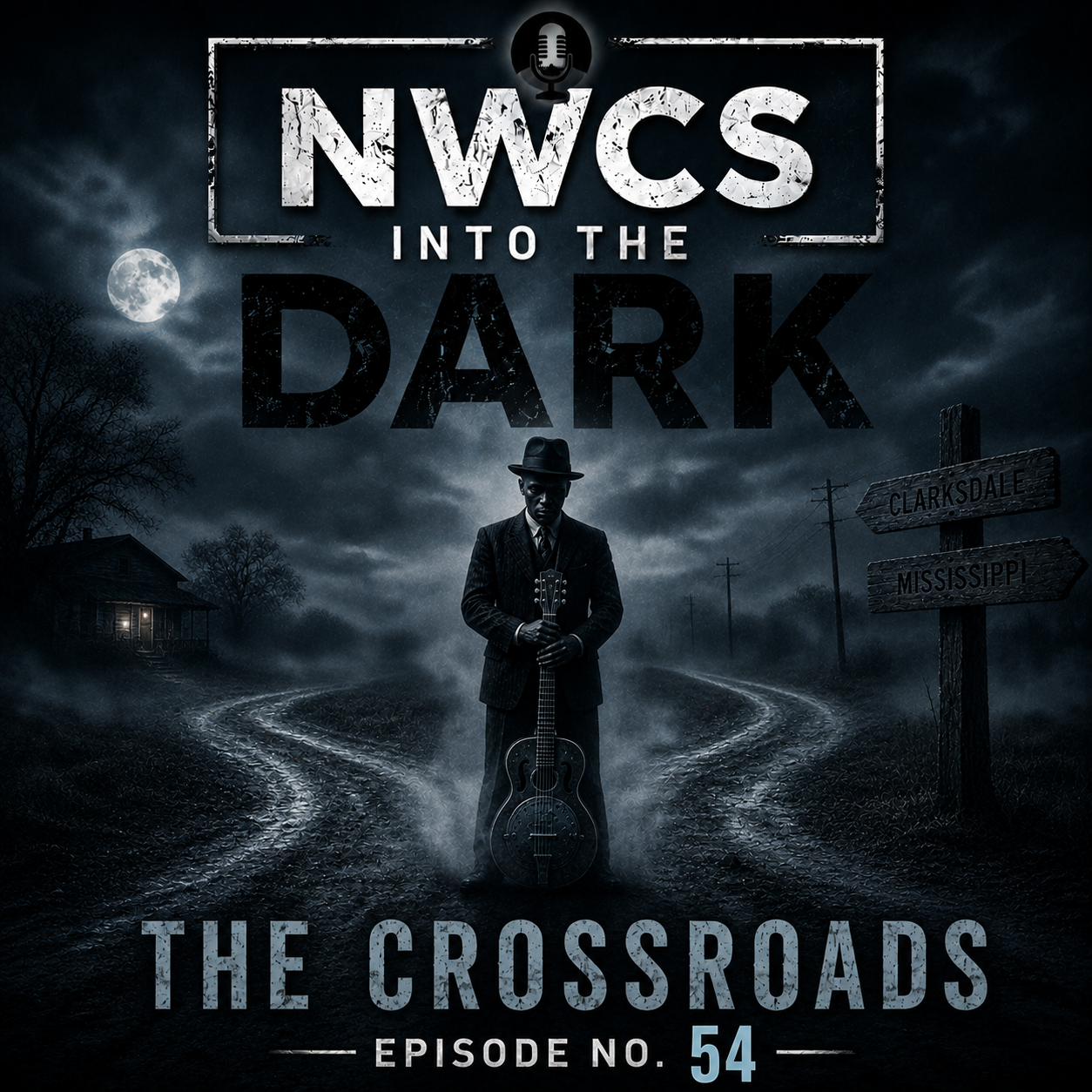
They say if you find the right crossroads, one that hums just right under the moonlight, and you show up alone at midnight with your guitar in hand, a man might appear, tall, shadowed, dressed like someone you've already met in a dream.
He'll take your guitar, tune it, maybe play a few licks, and then he'll hand it back to you.
And just like that, you'll play like a professional.
But the deal ain't free.
Tonight on nwcs. Into the dark we talk. We walk down the dirt path to the most haunted intersection in American history.
The crossroads. And we follow the trail to a club no one wants to join, but too many have entered the 27 Club.
Welcome to this episode of NWCS. Into the Dark and the crossroads.
Welcome.
[00:02:03] Speaker B: Hey.
[00:02:04] Speaker A: In the studio this evening, we've got tab Ahoy. We've got Rob.
No, not a fan. And we've got all the way from somewhere in California. Danny.
Oh, yeah. Oh, yeah. And our special guest in the studio, Paris.
[00:02:22] Speaker E: Hola.
[00:02:24] Speaker B: Hola.
[00:02:25] Speaker A: Okay. Welcome. Greetings. Anything new? Anything new with the group?
[00:02:30] Speaker B: I always feel like this is a stumper.
[00:02:32] Speaker F: I know. It is, totally.
Because we need to do these back to back.
[00:02:36] Speaker B: It's the hard, hardest part of the episode.
[00:02:39] Speaker F: It is. It's the awkward part.
[00:02:40] Speaker B: What's new?
[00:02:41] Speaker C: It's amazing. Hard. Oh. What? Rob, Where's Danny?
[00:02:45] Speaker B: Yeah. Can you not see me?
[00:02:46] Speaker C: Yeah, I see you.
[00:02:48] Speaker B: Where am I? I'm in California.
[00:02:53] Speaker F: Okay.
[00:02:54] Speaker C: No, Jesse.
[00:02:55] Speaker B: Yeah. Nothing new on my end that I can think of.
[00:02:59] Speaker C: Just doing far more.
[00:03:00] Speaker A: Y'.
[00:03:01] Speaker C: All.
[00:03:01] Speaker A: Y' all know what the. Y' all know what the crossroads are? Hell, yeah, I have a clue.
What do you think?
[00:03:07] Speaker B: General idea?
[00:03:08] Speaker A: General general.
[00:03:10] Speaker F: These people didn't make it past the age of 27.
[00:03:14] Speaker C: No, he. He spoke about it in the intro a little bit.
[00:03:17] Speaker F: Yeah, a little bit.
[00:03:18] Speaker A: He wasn't paying attention.
[00:03:19] Speaker C: Basically selling your soul to.
[00:03:21] Speaker F: Right, right. I know that.
[00:03:22] Speaker C: Do you. But do these tie together?
Yeah, but there are. These seem to be two different things.
[00:03:28] Speaker A: They tie together. We'll get into how they tie together, but basically. Sorry for jumping ahead, but basically, in folklore, especially Southern hoodoo and African traditions, the crossroads is more than a lonely country. Intersection. It. It's a portal.
[00:03:41] Speaker D: Whoa.
[00:03:42] Speaker A: A meeting place between the living and the dead, between the divine and the damned. In Hoodoo, the crossroads is where you perform a ritual where spirits can be summoned, deals can be made. Some say that the God Legba stands there as the gatekeeper. Others say it's Satan himself.
[00:04:01] Speaker F: Can you pronounce that again?
[00:04:02] Speaker A: Yeah. Legba.
[00:04:03] Speaker F: Legba.
[00:04:04] Speaker A: Yeah.
[00:04:04] Speaker F: Okay.
[00:04:09] Speaker A: Others say it's Satan himself looking to trade talent for eternity. And in American blues lore, the crossroads are where magic happens. But it comes with a price, especially for one well known blues musician, Robert Johnson. Which is where our podcast begins. Robert Johnson was born in 1911 in Mississippi. Played a little, sang some, but nobody thought much of him until he disappeared. When he came back, Robert Johnson could play like no one had ever heard before. Fingers flying, guitars wailing, voice echoing like a seasoned and talented musician. That's when people started talking. Johnson himself hinted at this in many of his songs. He sang about meeting the devil, about being chased by hellhounds, about going down to the crossroads to try to flag a ride. And then, like so many, so many talented blues men, he died mysteriously at the age of 27. Some say poison, some say jealousy, some say the deal came due. Did he really make a deal? Or was he just able to teach himself how to play in a very short period of time? That's the crossroads, my friends.
[00:05:12] Speaker B: Interesting.
[00:05:13] Speaker A: Making a deal, play the guitar like nobody's business. So if you look at the story of Robert Johnson, he was a very short period of time. So nobody. He would play on the street corners. They wouldn't even let him play in clubs. He played on the street corners and everyone just kind of passed by. They didn't even put any money in his shoe because he just didn't play very well. And then he disappeared. And it was for a very short period of time. It was like two months or something like that. And then he came back and it was just like this phenomenal blues musician. I just don't think that you can teach yourself to play and sing to the degree that he did in that short period of time. But then especially when you listen to his music and you listen to, you know, he's, he's actually talking about going down to the crossroads and making a deal. It's in many of his songs.
But, you know, I mean, they said that he died mysteriously at 27. But if anybody knows anything about Robert Johnson, apparently he was quite the player and from the Himalaya. And so he would sleep with a lot of married women.
And that's dangerous. Yeah. So some say that he was, he was poisoned or killed by a jealous husband.
[00:06:17] Speaker C: That'll do it.
[00:06:19] Speaker A: That'll do it.
[00:06:20] Speaker B: Is the crossroads, like.
So it's a destination or it's a, it's a.
[00:06:25] Speaker A: Is it more like a space between. It's more of a metaphorical destination. I imagine that the crossroads could be anywhere. And some people believe the crossroads is just, you know, a decision you're making in your mind. That being the crossroads, not an actual intersection.
[00:06:43] Speaker C: I picture. I'm not gonna give us our location exactly, but we're in the sticks and I picture like, you know, a four way actual crossroads where you really can't see the destination on either way. You go and you, you have a
[00:06:59] Speaker A: decision to some Mississippi backs road.
[00:07:02] Speaker C: Yeah, yeah, I do it.
[00:07:04] Speaker B: But you can't, you can't like throw it in your GPS and like, I'm gonna go down to the crossroads and I totally do.
[00:07:11] Speaker A: Yeah. I don't think that it's. I don't think that it's a physical place.
[00:07:14] Speaker B: Interesting.
[00:07:15] Speaker A: I think that the crossroads is wherever you make that decision that you're willing to sell your soul to the big man. You know, I don't think that's an, an actual location, but.
[00:07:24] Speaker B: Right.
[00:07:25] Speaker C: I, I would do it to play the kazoo like nobody else you would
[00:07:30] Speaker A: sell your soul to.
[00:07:31] Speaker B: Well, he's made a kazoo market that's like.
[00:07:33] Speaker A: It's not. It doesn't really actually take a whole lot of talent to play the kazoo in the first place.
So it seems like you could wish for something a little higher on the scale.
[00:07:43] Speaker B: I mean, there's a lot of other things.
[00:07:45] Speaker A: For real.
[00:07:48] Speaker F: Rob's trying to hold it in.
[00:07:51] Speaker B: So is this. So, okay, it's.
[00:07:53] Speaker A: Are there any, Are there any famous kazoo musicians?
[00:07:57] Speaker B: Musicians?
[00:07:57] Speaker F: Well, if he made a deal with the devil, there probably would be famous.
[00:08:02] Speaker C: You would hear about. Yell at Rob.
[00:08:05] Speaker A: Danny, can you, on the top of your head, can you come up with any famous kazoo musicians?
[00:08:11] Speaker B: No, not at all. Not at all.
[00:08:13] Speaker A: That's. That's who Rob's willing to sell his soul to be that one guy. To be that famous.
[00:08:18] Speaker C: I mean, it would be like, you know, a couple different.
[00:08:21] Speaker A: Ladies and gentlemen, it's Rob on his kazoo.
[00:08:25] Speaker B: I suppose. Stranger things.
[00:08:27] Speaker F: You kind of need to start with a kazoo.
[00:08:28] Speaker C: And then that one looks
[00:08:32] Speaker A: like the car. Slide whistle.
[00:08:33] Speaker F: Yeah, Slide whistle. There you go.
[00:08:35] Speaker C: Yeah. Master slide whistle.
[00:08:37] Speaker B: Well, you know, now you're just asking for too much.
[00:08:40] Speaker A: Our next episode. If Rob comes In playing the kazoo like a madman. We know. We know he sold his soul.
[00:08:48] Speaker B: I know something like that. I know.
[00:08:50] Speaker A: It is warm in here.
[00:08:51] Speaker F: Yeah, this. This is like a sweatshop.
[00:08:54] Speaker C: Yeah.
[00:08:55] Speaker A: So Robert Johnson died at 27. And there was a lot of other famous musicians that also died eerily at the age of 27.
[00:09:06] Speaker B: And so how do you eerily die?
[00:09:08] Speaker A: Well, under mysterious circumstances and all at the age 27. Which is somewhat eerie.
Okay, I guess you got a joke for us.
[00:09:16] Speaker E: Not at the moment.
[00:09:18] Speaker D: What?
[00:09:18] Speaker C: What?
[00:09:19] Speaker A: Your whole purpose is to be on here is to tell a joke.
[00:09:23] Speaker B: Is that. Is this the right place?
[00:09:25] Speaker A: She has one job you fired. I was testing her, Danny.
[00:09:28] Speaker B: And we're going to. Eerily.
A lot of people have eerily died. Hey, Paris, do you have a joke for us?
[00:09:34] Speaker E: Yeah, it's not very good timing.
[00:09:36] Speaker A: Well, it's a test we're terrible at the time. Failed.
[00:09:40] Speaker B: Yeah.
[00:09:40] Speaker A: You guys know the other.
Some of or a list of other musicians that died at age 27.
[00:09:49] Speaker C: I see a bunch in front of me on the paper.
[00:09:52] Speaker A: Well, you have the notes.
[00:09:54] Speaker C: Okay.
[00:09:55] Speaker A: Do you know anybody? Do you know anybody that's not on these notes?
[00:09:58] Speaker C: No, I can't think of.
[00:09:59] Speaker A: Kurt Cobain was one. Y died at age of 27 and shot and killed himself.
[00:10:05] Speaker C: Shotgun.
[00:10:06] Speaker A: Janice Joplin. She died at age 27.
Jimi Hendrix. Jimi Hendrix died at 27. Amy Winehouse.
[00:10:14] Speaker F: Yeah.
[00:10:15] Speaker B: One of my favorite artists. She was a very. I mean, all of these people are talented, but I love Amy Winehouse.
[00:10:21] Speaker C: Yeah, there are some good.
[00:10:22] Speaker A: I'm not sure that Janice Joplin was super talented.
[00:10:25] Speaker F: No, she had a style, though.
She was very had.
[00:10:29] Speaker C: She had her. It for the time.
[00:10:31] Speaker B: It was impactful, right?
[00:10:33] Speaker F: Totally.
[00:10:34] Speaker C: I mean, she was just kind of a screaming whatever.
[00:10:38] Speaker A: I never. You're.
[00:10:39] Speaker B: You're going to get a bunch of hate mail for that one.
[00:10:41] Speaker F: Yeah, I think you are.
[00:10:42] Speaker C: Yeah. That was very unique.
[00:10:47] Speaker A: All I said was I do not care for her. People are allowed to have their own opinions.
[00:10:52] Speaker F: Sure, sure.
Just don't like the stuff.
[00:10:54] Speaker A: Brian Jones. Yeah, Brian Jones.
[00:10:57] Speaker B: To Scott.
[00:10:58] Speaker A: One of the founding members of the Rolling stones. Died at 27. Jim Morrison.
[00:11:03] Speaker F: Jim Morrison. Yeah.
[00:11:05] Speaker A: Richie Edwards of the Manic Street.
[00:11:07] Speaker F: And did you know his girlfriend also died at the age of 27, like three years later?
[00:11:12] Speaker A: Really?
[00:11:12] Speaker B: Jim Morrison.
[00:11:13] Speaker F: Yeah.
[00:11:14] Speaker B: Oh, wow.
[00:11:14] Speaker F: His girlfriend.
[00:11:15] Speaker A: Wow.
[00:11:15] Speaker C: The. The Richie Edwards one is crazy because of the. How.
[00:11:22] Speaker A: Yeah, it was all, you know, death shooting.
[00:11:24] Speaker C: Well, he vanished without a trace, and then he was legally declared dead in 2008, so.
[00:11:31] Speaker B: And still no trace.
[00:11:33] Speaker C: Yeah, that's crazy.
[00:11:34] Speaker A: Talk about another person on Weird Timing was Kristen Pfaff, who was the bassist for Hole.
You guys probably know that Hole is Courtney Love's band. Courtney Love was girlfriend of Kurt Cobain and.
[00:11:50] Speaker F: Yeah, the replacement, Right.
[00:11:51] Speaker A: Yep. She died two months after Kurt Cobain at age 27.
[00:11:55] Speaker C: Oh, these were all 27.
Okay.
[00:11:58] Speaker A: And then Pete Ham.
[00:11:59] Speaker F: Who.
[00:12:00] Speaker A: Hang on a sec.
[00:12:01] Speaker C: Badfinger. So then.
[00:12:02] Speaker A: And then there was Bob Dylan, although he didn't. He didn't die at age 27, obviously, because he's still alive. But he did do a interview. Why do you still on 60 Minutes? I was interviewed and he actually talked about selling his soul. It's kind of interesting.
[00:12:18] Speaker B: Why do you still do it? Why are you still out here?
[00:12:20] Speaker A: Well, it goes back to the destiny thing.
I made a bargain with it, you know, long time ago. And I'm holding up my hand.
What was your bargain? To get where I am now.
Should I ask who you made the bargain with?
You know, with the chief Commander.
[00:12:43] Speaker B: On this Earth.
[00:12:45] Speaker A: On this earth. And then in a world we can't see. Interesting.
[00:12:49] Speaker F: Chief commander?
[00:12:50] Speaker B: Yeah.
[00:12:51] Speaker A: Chief commander.
[00:12:52] Speaker C: That's weird.
[00:12:53] Speaker B: I've been playing around with this idea on this of the 54 Club.
[00:12:58] Speaker F: The 54 Club?
[00:13:00] Speaker B: Yeah. This is two times the 27 Club.
And some. Some people in there that might be considered, you know, maybe they made it to this stage in life and got past that 54 age and. And outlived some of those others that maybe fell in the. In the 27 Club. But some people, some notable folks in that age range that are still potentially performing or performed for a long time after Ozzy Osbourne, Iggy Pop, Keith Richards, Courtney Love. We've mentioned her name a few times. Trent Reznor and Bob Dylan.
[00:13:35] Speaker F: Wow.
[00:13:36] Speaker B: Yeah.
[00:13:36] Speaker C: Interesting. And none of them can play the gazoo.
[00:13:40] Speaker F: Who was the first person? You. You was on your list?
[00:13:42] Speaker A: You're correct, Rob. None of them.
[00:13:43] Speaker F: Your first person on the list, Ozzy Osborne. Yeah, I guess he's not doing too good right now.
[00:13:48] Speaker A: No, he just did a. He just did a farewell concert.
[00:13:51] Speaker F: Yeah.
[00:13:51] Speaker C: Yeah.
[00:13:52] Speaker B: See you later. Yeah.
[00:13:53] Speaker F: How old is he?
[00:13:55] Speaker A: Like 106. I think I need to look.
[00:13:57] Speaker C: Yeah, I think he's like 80s. No.
[00:14:00] Speaker F: Well, I mean, I guess it's. It all depends on when you made this deal too. I mean, after 27, after 54, whatever.
[00:14:08] Speaker B: Did they get past their 27?
[00:14:11] Speaker A: 76.
[00:14:12] Speaker C: 76 years old, 27 deal.
[00:14:14] Speaker A: You think you would have learned to play the kazoo by now.
[00:14:16] Speaker C: I know, right?
[00:14:17] Speaker B: Right.
That is a thing.
[00:14:19] Speaker A: But if you but if you look at. I mean, if you want to look at this from a different point of view, I mean, you look at those artists, Kurt Cobain, Jim Morrison, Jimi Hendrix, Amy Winehouse. I mean, most of these people had major addiction issues. I think it's, you know, clearly it's coincidental that it was, you know, they died at age 27. But, you know, I mean, I think their lifestyle contributed obviously to their ultimate demise. But then, you know. But then again, you have Kurt Cobain, who also in a lot of his songs would talk about death.
[00:14:53] Speaker C: He controlled his destiny.
[00:14:55] Speaker A: Right.
[00:14:56] Speaker C: Or he was.
[00:14:57] Speaker B: What?
[00:14:57] Speaker C: Or he was killed.
[00:14:58] Speaker B: What is the symbolism, you suppose, of the number 27? Like why 27 in that instance?
[00:15:05] Speaker C: Good question.
[00:15:06] Speaker F: Well, I guess the number 27 in new numerology is wisdom and enlightenment.
[00:15:15] Speaker A: Ultimate enlightenment.
[00:15:16] Speaker F: Yeah, something like that.
[00:15:17] Speaker A: I mean, you're giving. You're giving self sacrifice. You're giving 20 some year olds millions of doll. You know, these go down the path of destruction pretty quick.
[00:15:29] Speaker B: I like that idea of, you know, the, you know, there's probably some playing around you can do with like numerology, like you said, some sort of meaning behind the numbers. I see. Like the number two can be a blend of duality or its meaning is duality or harmony. And the number seven is mystery or spiritual death. So is it that they reach their enlightenment at that age? Is that what it is? Is that what it means? I don't know. Completion or the ending or transition.
[00:15:57] Speaker F: Well, then they suggest cubing. Cubing meaning 27. 27.
[00:16:02] Speaker A: Is that anything like intensified creative power?
[00:16:05] Speaker B: Three cubed is 27, right?
[00:16:07] Speaker F: Yes.
Or 27 cube significance there? Intensified creative power.
[00:16:13] Speaker B: Yeah, interesting.
[00:16:15] Speaker C: Very, very, very, very fascinating.
[00:16:17] Speaker B: Is the number 27 part of the Fibonacci sequence? Has anyone checked into that?
[00:16:23] Speaker A: No, Anunnaki. I'm sorry, what?
[00:16:26] Speaker F: Fibonacci 27, isn't it.
[00:16:28] Speaker A: Isn't he the comic number? Isn't he the guy that played the piano and wore all the flashy stuff?
[00:16:34] Speaker C: No, not liberace.
[00:16:35] Speaker A: Oh,
[00:16:39] Speaker F: 27 is the atomic number of cobalt.
[00:16:42] Speaker B: Oh, there's something to. To kind of examine. I didn't even think about that.
Yeah, like to look this like.
[00:16:49] Speaker F: Like, like in the blues.
[00:16:53] Speaker A: Fascinating.
[00:16:54] Speaker C: You know, you always know when Scott's not listening. Interesting, interesting, fascinating, interesting, fascinating. Okay, so who watched the movie Crossroads?
[00:17:04] Speaker A: That was not part of her homework.
[00:17:06] Speaker F: But what was the movie about?
[00:17:07] Speaker A: It was actually really, really. Well, there's several different movies.
[00:17:10] Speaker C: No, with the one with Ralph Macchio, 1986. That was a good one. It was good. That would have been a good, good movie, too, for us to watch. But I watched. I can't remember the last time I watched it, but it was pretty cool. I like, when I was younger, in 86, when I watched it, I. When I was like, two.
No, I don't. No, I was like, 18 when I watched it.
[00:17:32] Speaker A: Is there a moral to this?
[00:17:33] Speaker C: No, I wasn't 18.
No, what I'm saying was the movie was really good. I really, after watching it, was wanted
[00:17:41] Speaker A: to play similar to what we're talking about. Is it like.
[00:17:43] Speaker C: No. Yeah.
[00:17:44] Speaker A: Well, it sells a soul or something.
[00:17:46] Speaker C: Well, basically, a good. A guitar student, which is played by Ralph, tours the Deep south with an old blues man chasing a lost song. Supposedly a lost song written by Robert Johnson.
[00:18:01] Speaker A: And that would have been a good movie.
[00:18:03] Speaker C: Yeah, he learns to. He learns some of the techniques of playing the guitar better while he was going along. And really cool. I really wanted to play the guitar after that.
[00:18:13] Speaker B: Yeah.
[00:18:14] Speaker C: I settled for the kazoo.
[00:18:17] Speaker A: And apparently you're not very good.
[00:18:18] Speaker C: I'm not very good at it.
[00:18:20] Speaker B: How old were Stevie Ray Vaughan? I have to look that up.
[00:18:22] Speaker C: Oh, yeah.
[00:18:23] Speaker F: Got any jokes for us, Paris?
[00:18:25] Speaker E: I do have a joke.
[00:18:26] Speaker A: Let's hear it.
[00:18:26] Speaker E: It's a Louisiana joke.
[00:18:28] Speaker A: Okay. Ooh, Crossroads. Good enough.
[00:18:30] Speaker F: You got your. Your dad's attention.
[00:18:32] Speaker E: What's a Louisiana shrimp's favorite dance?
[00:18:35] Speaker A: What's a Louisiana shrimp's favorite dance?
[00:18:39] Speaker E: Yeah.
[00:18:44] Speaker A: I don't know.
[00:18:44] Speaker E: The Crayola Shuffle.
[00:18:47] Speaker F: That one's good.
[00:18:48] Speaker C: 35.
[00:18:50] Speaker E: Nobody laughs at my jokes. I shouldn't be the joke person anymore because nobody laughs at my jokes.
[00:18:56] Speaker B: Wait, wait, wait. I got you. I got you.
Thank you.
[00:18:59] Speaker E: That makes me feel better.
[00:19:01] Speaker B: Oh, my.
[00:19:02] Speaker A: You guys ready for a music?
[00:19:03] Speaker C: Stevie Ray Vaughan died at 35. 35 in a helicopter crash.
[00:19:08] Speaker A: Interesting. Yeah.
[00:19:09] Speaker F: 35.
[00:19:10] Speaker C: 35.
[00:19:11] Speaker A: Fascinating.
[00:19:11] Speaker B: One of the best blues players in my opinion.
[00:19:13] Speaker A: Underrated for sure.
[00:19:15] Speaker C: Yeah, he was good.
[00:19:16] Speaker A: Speaking of which, Mondo is in the studio. He's going to do a. A live performance for us. You guys ready?
[00:19:22] Speaker C: Hey, Mondo. Welcome. In here.
[00:19:26] Speaker A: He's going to do musical interlude. You guys ready? Hello, Mondo, you ready? Yeah.
[00:19:32] Speaker B: Let's go.
[00:19:35] Speaker C: Is that.
[00:19:37] Speaker A: Is that how you think Mondo sounds? All right. Hit it, Mondo.
[00:20:05] Speaker D: Midnight wind the sky runs cold I heard there's a place where you sell your soul.
And down at the crossroads Past the trees a shadow ways Makes deals with ease Fame and fortune A heavy crown but when time runs out the devil comes around.
The crossroads that's where you'll Bleed Trade your soul for the things you need the crossroads A shadow deal what you give away.
The dark will steal.
27 candles names in stone Voices echo But the body's gone Songs still play, crowds still weep but the cost you pay Cuts way down deep.
The crossroads that's where you'll bleed Trade your soul for the things you need the crossroads A shadow deal what you give away.
The dark will steal.
Strings on fire, silver tongs but no one wins when the deal is done Some say they saw the devil's grin Every glory has to sin.
The crossroads that's where you bleed
[00:23:22] Speaker A: Trade
[00:23:23] Speaker D: your soul for the things you need the crossroads A shadow deal what you give away.
The dark Will steal.
Into the dark the stories keep northwest Curiosity cut so deep.
Wow.
[00:24:39] Speaker A: Mondo, that was amazing.
[00:24:42] Speaker C: Thank you.
[00:24:43] Speaker B: Bravo, bravo.
[00:24:44] Speaker C: Bigger.
[00:24:46] Speaker B: Thank you.
[00:24:47] Speaker C: Thanks, brother.
[00:24:49] Speaker A: Oh, my goodness. Danny, the crossroads. What do you got for us?
[00:24:55] Speaker B: I mean, most of it, I guess, we kind of threw out there, but for me, it's the. I think about the significance in the. In the. Excuse me. The meaning behind the number 27. It's.
I find that when, you know, looking at this, obviously there's a pattern there, but what does. What is the different significance there of that number? We talked a little bit about, like, the numeric numerology or the spiritual symbolism in those particular numbers.
You know, some say there could be a tie in. To the occult.
There was a book in the Book of Jubilee. Rather, 27 is seen as an angelic orders or divine cycles. Some occultists claim 27 represents death, reconstruction or transformation. And then in alchemy, 27 is associated with Lee. With lead, or a base. Or lead, rather, a base element seeking purification. That could be a metaphor, right, for the tortured artist. And so what was it? I think Tab said it was on the periodic table. It's cobalt.
[00:26:02] Speaker F: Cobalt?
[00:26:02] Speaker C: Yeah.
[00:26:03] Speaker B: Okay. How close are cobalt and lead related?
I don't know. Are those similar materials? But anyway, it's. It's interesting to me that 27 and then, you know, there's all these other things you could surmise, I guess, from that, you know, that. As to the implication, I did look up to see if it was one of the Fibonacci Sequence numbers. It is not.
The 27th number in the Fibonacci sequence is 196,418. So I don't know. I didn't get a chance to look, to see what that might.
What that might mean, if there's any sort of correlation. Playing off that numerology again. But in any Case. Well, there's curious.
[00:26:43] Speaker A: There's lots of other artists, too. You know, you never know what to believe when you're on Facebook or Tick tock or whatever. But you got. You got groups like the Island Boys, and you got that one Island Boy who's, you know, crying on camera, talking about how you sold his soul and.
[00:26:58] Speaker B: Yeah.
[00:26:59] Speaker A: Doja Cat and a lot of Sam Smith. Sam Smith. And.
And you look at them before and after, and there's a huge difference.
I don't know that Sam Smith or. Or even Doja Cat has actually admitted that they sold their souls, but I don't think they have Island Boys.
[00:27:17] Speaker E: But the transition of before and after is crazy.
[00:27:19] Speaker A: Right, Right.
[00:27:20] Speaker B: I feel like. Yeah, I feel like there was a noticeable difference.
And, you know, Sam Smith took that hit on the.
What is it? Copyright? Or like, he used someone's song or something, so maybe, like, the melody was similar. Yeah, yeah, he took that hit. And then afterwards, I mean, I jam out to some. Some Sam Smith.
[00:27:42] Speaker F: I won't.
[00:27:42] Speaker B: I won't deny that. Yeah.
[00:27:44] Speaker A: I think it's.
[00:27:45] Speaker F: I think it's. It's. I think it's strange because I even looked up, like, famous actors that died at 27, and the ones. And ones that they consider famous, I. I don't really consider famous. Famous. Not like the. Like the singers. And then I was like, okay, what about art? What about paintings? You know, famous painters.
[00:28:02] Speaker B: Yeah.
[00:28:03] Speaker F: And there's really not a lot of them either. So it's kind of strange that it's kind of centralized around the music industry where.
[00:28:08] Speaker B: Right.
[00:28:09] Speaker F: These people are dying at a very young age.
[00:28:11] Speaker B: Yeah.
[00:28:12] Speaker F: Yeah. And I would go back to what Scott was saying earlier is that it's. It's the lifestyle.
[00:28:15] Speaker A: Yeah.
[00:28:16] Speaker B: Right. Right.
[00:28:17] Speaker A: What.
How old was Chris Farley when he died?
[00:28:20] Speaker F: He was older than 27, I'm sure.
[00:28:22] Speaker A: Was.
[00:28:22] Speaker B: Yeah. I know we didn't do a movie review on this one, but I was thinking about. Actually, it seems like I have to dig into this, too, a little bit more, but there was a movie, horror movie that came out this year called Sinners, and it features a Southern musician. Well, whole bunch of Southern musicians in this. And it seems to. I don't think it's directly related to kind of the crossroads, but it's that whole concept of. Of, you know, doing whatever it takes to become successful and. And, you know, maybe being faced at the crossroads, maybe metaphorically in some way. It is. But you guys got to watch that movie. I think, Scott, you'd really like it. Yeah, it's Very. It's a. It's a Southern based movie.
[00:29:01] Speaker F: So what was the movie again?
[00:29:03] Speaker B: Sinners.
[00:29:04] Speaker F: Sinners.
[00:29:04] Speaker C: Sinners.
[00:29:05] Speaker B: Yeah.
[00:29:06] Speaker F: Gosh, I think I've seen that.
[00:29:07] Speaker A: Sounds interesting.
[00:29:08] Speaker B: It just came out this year pretty well. Yeah. Michael B. Jordan plays a set of twins in the movie.
[00:29:15] Speaker F: Oh, okay. Yeah. So maybe. Yeah, I saw the trailer for it.
[00:29:17] Speaker B: Yeah. Yeah. But there's. There's a very heavy music element in this. And religious themes and.
And this idea of. Well, I won't spoil it. Spoiler alert. I'm sorry.
[00:29:29] Speaker C: No, that looks revealing.
Spoiler.
[00:29:33] Speaker D: Oh, no.
[00:29:34] Speaker F: Now you got Rob going.
[00:29:35] Speaker C: No. That does look like a good movie, though.
[00:29:38] Speaker B: Yeah. Yeah, it's worthwhile. Worthwhile.
[00:29:40] Speaker A: At least we're off the tractor beam.
[00:29:44] Speaker C: Ready?
[00:29:45] Speaker F: No, no, no.
[00:29:52] Speaker C: Wow. How many episodes did that, Carrie?
[00:29:55] Speaker F: I don't know.
[00:29:55] Speaker B: Five or six.
[00:29:56] Speaker C: Yeah. Anyway. And it haunts us to this day.
[00:30:00] Speaker A: Still haunts us to this day. You guys ready to move on?
[00:30:04] Speaker C: Yeah.
[00:30:09] Speaker A: It's time for everybody's favorite game show, Deal or no Deal.
Oh, boy. Since we're talking about deals, I'll take it. I have a new game for everybody. Deal or no Deal.
[00:30:25] Speaker B: Do I have to sell my soul?
[00:30:27] Speaker A: Well, I'm gonna give you a deal, and you have to decide if you're gonna take it or not.
It has a because.
Because with every deal, there's consequences, right?
[00:30:36] Speaker B: Oh, boy. Oh, boy.
[00:30:37] Speaker A: Okay, we're gonna start with Tab. Oh, boy.
The offer.
You get global fame.
[00:30:44] Speaker F: There's no background music to this.
Oh,
[00:30:50] Speaker A: thank you, Tab. My sound edit. Who's gonna edit?
All right, here's. Here's the game, guys. I'm gonna give. I'm gonna give each of you guys a Deal or no Deal.
Tab, you're going first.
[00:31:10] Speaker F: Swell.
[00:31:11] Speaker A: Tab, you get. You get global fame and an eternal Spotify number one hit.
But every time someone streams your song, you have to hear Jesse whisper bullying. Whisper bullying. You in your closet for 30 seconds.
[00:31:30] Speaker F: No deal.
[00:31:31] Speaker A: No deal.
Danny, you ready?
[00:31:35] Speaker B: All right, let's do this.
[00:31:36] Speaker A: You get a black American Express with no limit.
[00:31:41] Speaker D: Why?
[00:31:41] Speaker C: Why did you.
[00:31:42] Speaker A: You get a black American Express with no limit. But every purchase comes with a video message from Rob saying, this is why you'll never be loved. While licking an envelope slowly.
How did you find my.
Where did you get Danny?
[00:32:00] Speaker B: Oh, my. That was yesterday.
[00:32:01] Speaker A: Deal or no Deal?
[00:32:05] Speaker C: This is what you get.
[00:32:08] Speaker B: Do I have to pay it back?
[00:32:11] Speaker A: No deal.
[00:32:13] Speaker C: This is what you get.
[00:32:17] Speaker A: No deal.
[00:32:17] Speaker B: All right, no deal.
[00:32:21] Speaker C: Take it. Oh, wait. Go ahead.
[00:32:23] Speaker A: You get $10 million in cash tomorrow.
But every time you Spend a hundred dollar bill.
Tab appears behind you and leather chaps and moans.
Swipe it, daddy.
[00:32:36] Speaker C: I definitely. I'm taking that.
[00:32:39] Speaker A: You're taking it?
[00:32:40] Speaker C: Oh, yeah. And I. Yeah, I'm taking it all the way to the bank, baby.
[00:32:43] Speaker A: All right, all right.
[00:32:44] Speaker F: So I'm a card bearer.
[00:32:45] Speaker C: I had a dream like that once.
[00:32:47] Speaker A: What?
[00:32:48] Speaker C: What?
[00:32:50] Speaker A: You want to elaborate?
[00:32:53] Speaker F: No.
[00:32:54] Speaker B: No.
[00:32:54] Speaker A: All right. Paris, you wake up with a 20 million dollar bank balance.
But once a week, Tab locks eyes with you during breakfast and seductively eats a hot dog While playing Kenny. While playing Kenny Joe.
[00:33:11] Speaker E: No deal. No deal.
[00:33:14] Speaker A: While playing Kenny G on a cassette.
[00:33:16] Speaker F: $20 million.
[00:33:17] Speaker E: No deal.
[00:33:19] Speaker A: Tab locks eyes with you during breakfast and seductively eats a hot dog while playing Kenny G on a cassette.
[00:33:25] Speaker E: No deal.
[00:33:26] Speaker D: No deal.
[00:33:27] Speaker E: No deal.
[00:33:28] Speaker F: Where did that come from? The nether.
[00:33:30] Speaker C: Another dream he had.
[00:33:33] Speaker B: Wow.
[00:33:33] Speaker A: I did have a dream about that.
[00:33:35] Speaker F: That's odd.
[00:33:36] Speaker A: Tab. Oh, boy. You become the greatest blues singer of all time, but Danny becomes your full time hype man. And whispers, that's my baby boy.
Every line you sing.
[00:33:51] Speaker F: Every line?
[00:33:52] Speaker A: Yep. After every line you sing.
[00:33:54] Speaker F: No deal.
[00:33:55] Speaker C: No, that's a lot. Mine's great.
[00:33:58] Speaker F: Yeah. You guys got money?
[00:33:59] Speaker A: Danny.
[00:34:00] Speaker B: That's my. That's my baby boy.
[00:34:02] Speaker F: That's my baby boy.
[00:34:03] Speaker A: That's my baby boy. You, Danny, this baby back.
[00:34:06] Speaker B: Baby back.
[00:34:08] Speaker A: You inherit a private island and $30 million.
But Rob is your butler.
And he only communicates through erotic poetry and interpretive dancing.
[00:34:21] Speaker B: Naked.
[00:34:22] Speaker D: Naked.
[00:34:23] Speaker F: Oh, boy.
[00:34:25] Speaker C: Ew.
[00:34:26] Speaker A: Private island. $30 million, but robbed your butler. And he only communicates through erotic poetry and interpretive dance.
[00:34:33] Speaker C: I mean, you could just put me in the butler quarters on the south end of the island.
[00:34:38] Speaker B: Hang on. I'm thinking about it.
[00:34:41] Speaker C: Because I. That's a win for me, too.
[00:34:43] Speaker A: That's my baby boy.
Deal.
You gotta take it. All right. All right.
[00:34:50] Speaker F: Danny's getting.
[00:34:51] Speaker A: All right. Paris, you're gifted with perfect pitch and your own private studio, but Rob insists on playing tambourine shirtless in the background on every track, loudly and badly and proudly.
[00:35:10] Speaker E: I'll do deal. Because I'll just edit it out.
[00:35:13] Speaker A: Nope, not able.
[00:35:15] Speaker E: Okay, deal.
[00:35:16] Speaker B: Okay, I'll do it. You're gonna want that cowbell in there, too.
[00:35:20] Speaker A: All right, Tab, you ready?
[00:35:22] Speaker F: Okay.
[00:35:22] Speaker C: Wait. Where's mine?
[00:35:24] Speaker A: You're next.
I have to go out of order here a little bit.
[00:35:28] Speaker F: We're missing some people. I think we're getting.
[00:35:30] Speaker A: We're missing people. Tab.
[00:35:31] Speaker F: Yes?
[00:35:32] Speaker A: You get paid a hundred thousand dollars every time you perform live.
[00:35:35] Speaker F: Okay.
[00:35:36] Speaker A: But Danny must tuck you into Bed every night while whispering erotic poetry in a Dracula voice.
[00:35:43] Speaker C: Win.
Winning.
[00:35:45] Speaker F: Every night.
[00:35:46] Speaker A: Every night.
[00:35:48] Speaker F: Winning only on the nights that I play.
[00:35:50] Speaker A: Every night.
[00:35:52] Speaker F: No. No deal.
[00:35:53] Speaker A: All right, Rob, you finally master the kazoo and earn Robert Johnson level legend status.
But Tab opens for you every night with a 45 minute spoken word poetry set entitled Moist Thoughts from My Mind Dealer. No deal.
Mastering the kazoo.
[00:36:20] Speaker C: The kazoo, you know, that's the.
[00:36:25] Speaker F: That's the deal.
You said you'd do it for a kazoo.
[00:36:28] Speaker C: No deal.
[00:36:29] Speaker B: No deal. All right.
[00:36:31] Speaker C: Do we have one for you, Scott?
[00:36:33] Speaker A: No, Tab, I'm sorry. Paris, your next tour sells out in under 60 seconds, but Jesse controls your wardrobe, and every outfit must include crocs, a cape, and visible nipple clamps.
Deal or no deal?
[00:36:52] Speaker E: No deal.
No deal.
[00:36:58] Speaker B: Can I take that one?
[00:37:00] Speaker A: All right, final one, Danny.
You get an international hit single that goes viral for years, but every time you perform it, Rob gets on stage behind you and reenacts emotional scenes from the Titanic with sock puppets.
Naked.
[00:37:22] Speaker E: You just added that in.
[00:37:23] Speaker F: Two or three sock bucket puppets.
[00:37:27] Speaker B: Where are the socks?
[00:37:28] Speaker C: Yeah.
[00:37:30] Speaker F: How many puppets are there?
[00:37:32] Speaker A: That's my baby boy.
[00:37:35] Speaker B: I'm gonna pass on that.
[00:37:36] Speaker A: You're gonna pass on that one? All right.
[00:37:38] Speaker B: Yeah, no deal.
[00:37:38] Speaker F: Okay.
[00:37:39] Speaker A: All right, Excellent.
[00:37:40] Speaker C: I got one for Scott.
[00:37:42] Speaker A: You got one for me?
[00:37:43] Speaker C: Yep, yep.
[00:37:44] Speaker F: Keep playing.
[00:37:46] Speaker A: All right,
[00:37:49] Speaker C: you get 100%.
[00:37:52] Speaker A: I'll take it.
[00:37:52] Speaker C: Ownership of the entire town that you live in.
[00:37:57] Speaker A: Okay.
[00:37:59] Speaker C: However, Jesse, every half hour, comes up and slaps you as hard as he can upside the head.
[00:38:11] Speaker A: No deal.
[00:38:11] Speaker C: Yep.
[00:38:14] Speaker A: No deal.
[00:38:16] Speaker F: Paris, did you sell your soul?
[00:38:18] Speaker B: No dice.
[00:38:19] Speaker F: Did you say no to all of them? I can't remember.
[00:38:21] Speaker E: I said yes to one of them.
[00:38:22] Speaker A: I think it wasn't selling your soul. I want to get that straight.
[00:38:25] Speaker B: The tambourine.
[00:38:25] Speaker F: Okay.
[00:38:26] Speaker C: Hey, by the way, Tab, I have chaps in my saddle bags.
[00:38:31] Speaker B: Oh, this is awkward.
[00:38:32] Speaker F: I made no deals.
[00:38:36] Speaker B: We interrupt this program to bring you a special report.
[00:38:39] Speaker A: All right, our man on the street reporter, Danny, what do you got for us?
[00:38:43] Speaker B: All right, so tonight's news takes a chilling turn into the real life tragedy from the paranormal world. Dan Rivera, a respected and well known paranormal investigator, US army veteran, and lead figure in the New England Society for Psychic Research, was found dead on July 13 in Yeti in a Gettysburg hotel. He was, get this, just 54 years old. Did we not just talk about that?
Rivera had just wrapped up a stop on the Devils on the Run tour, an event series featuring the infamous and allegedly possessed Annabelle doll. The same doll made famous By Warner's. By the Warner Warrens, rather, in horror films. The tour was sold out. The crowd was buzzing and then silence. When Rivera did not respond to calls, authorities entered the room. He was found unresponsive. There were no signs of struggle, no signs of foul play. And contrary to rampant speculation online, the Annabelle doll was not in the room. Was not in the room at the time of his death. The coroner has ruled the cause of death as natural, not supernatural, though full autopsy results are still pending. Still in a field where the unexplained often sits besides the unthinkable, the timing has stirred online theories and whispers. Did they follow him to the other side or follow from the other side?
Was it simply fate or, you know, can't really predict or protect with this himself from these type of things. But Rivera's colleagues remember him as a passionate investigator and a kind soul. Someone who never sought fame but pursued truth in the shadows. He leaves behind a legacy of curiosity, courage and compassion and a community of mourn. The community that mourns his passing will continue on his mission. Rest easy, sir, and may the veil welcome. Eugen.
[00:40:43] Speaker A: That's my baby boy.
So it says that he was. I saw this. You know, I mean, tragic for sure.
It says that he was a well known. See on any like, TV shows or. Does anyone know anything about his background as a paranormal investigator? Because they say he was. Well, they said he was well known, but in the.
[00:41:07] Speaker B: Yeah, kind of in the community. But my understanding is that he was on a TV show. I'm sorry.
Part of a society that.
In the area that he was from. Bear with me here. I have to go back to my notes.
[00:41:23] Speaker C: Where's my notes?
[00:41:24] Speaker A: That's my.
[00:41:25] Speaker B: Where's my notes?
He was part of a New England society for psychic research.
But I'm not sure about exact TV shows or things along those lines.
[00:41:37] Speaker A: Thank you. Thank you, Danny, for that very much. Appreciate your on the spot recording.
You guys ready to move on?
[00:41:45] Speaker C: Yeah, we're ready to move on.
[00:41:49] Speaker B: Let's do it.
[00:42:04] Speaker A: Northwest Curiosity Society brings you.
[00:42:07] Speaker C: What the. Was that?
[00:42:16] Speaker A: All right, Tab, you got something for us to guess here?
[00:42:18] Speaker F: Yeah, I'm going to kind of stay with the theme of the Singing Rocks of Montana from one of our last episodes. I don't think you guys are going to get this one. It's pretty interesting.
[00:42:28] Speaker A: Okay, get it ready.
[00:42:29] Speaker C: Get it going.
[00:42:48] Speaker A: Is it the singing rock of kalamazoo?
[00:42:52] Speaker F: No,
[00:42:59] Speaker B: I can't actually hear.
[00:43:00] Speaker F: They use this at a grocery store.
[00:43:05] Speaker A: What is found inside of a grocery store?
[00:43:08] Speaker B: A shopping cart.
[00:43:09] Speaker F: At checkout,
[00:43:13] Speaker B: a UPC scanner.
[00:43:15] Speaker C: The. The belt.
[00:43:16] Speaker E: Yeah, that's what I was thinking. The belt of the.
[00:43:18] Speaker F: Danny.
[00:43:19] Speaker A: Got it.
[00:43:19] Speaker F: The scanner, they've got these little barcodes that are different sizes and they're scanning across them and they're making all this musical notes with it. It's pretty. Pretty weird.
[00:43:28] Speaker B: Wow.
[00:43:28] Speaker F: That's. What. I got it.
[00:43:33] Speaker B: Yeah, you buy it.
[00:43:37] Speaker C: What? No, they. I. So they just take different items that make a certain sound and they just scan the.
[00:43:43] Speaker F: Yeah, it's a barcode scanner.
[00:43:45] Speaker A: That's fascinating.
[00:43:46] Speaker F: Change.
[00:43:47] Speaker C: Yeah.
[00:43:48] Speaker A: All right, gentlemen and lady, Great episode.
[00:43:53] Speaker C: Great.
[00:43:54] Speaker A: Love the crossroads. Thank you, Mr. Mondo, for coming to the studio and doing that song for us.
[00:43:59] Speaker C: Yeah, this is a good. Yeah.
Brother. Brother.
[00:44:07] Speaker A: Oh. Join us for our next episode. It's going to be super fascinating.
[00:44:14] Speaker F: It's a doozer.
[00:44:15] Speaker A: It's a whoopty woo for sure.
And maybe, just maybe, Rob will play the kazoo for us.
[00:44:29] Speaker B: Nighty night.
[00:44:33] Speaker A: Like us.
Follow us.
Listen to us, please.
Anyway, yeah. Nighty nighty, nighty night.
[00:44:50] Speaker C: Goodbye, my child.
[00:44:54] Speaker A: That's my baby boy.
[00:44:55] Speaker C: Baby back, baby back, baby back.