Episode Transcript
[00:00:07] Speaker A: Hear the Sasquatch howling in the night Paranormal beings come out to play.
Feel that chill upon your neck but do not fear when the rougarou barks because we'll follow you into the dark.
We'll follow you into the dark.
Into the Dark Contains subject matter and language that may be unsuitable for younger listeners. Listener discretion is advised.
[00:01:03] Speaker B: Tonight, I want you to imagine something.
You're leaving work, standing in your backyard. Or maybe you've just been awakened by people gathering outside.
Everyone is looking up, so you look up too.
And there it is. Something enormous.
Silent, motionless.
It isn't an airplane. It is in a helicopter.
And it isn't a drone.
Whatever it is, it shouldn't be there.
Within minutes, social media explodes. Thousands of videos from around the world.
Television networks interrupt their programming.
Military aircraft are launched.
Government officials tell everyone to remain calm.
Then another object appears. And another.
New York, London, Tokyo, Moscow.
Millions of people are watching.
Some believe it's an alien invasion.
Others think it's the second Coming.
The markets begin to crash.
Churches fill with worshippers.
Panic spreads across the globe. And then you hear a voice.
Not from your phone, not from a television, not from a speaker inside your head.
It tells you humanity is in danger.
The world must unite.
One government, one military, one authority.
One world.
But here's the question.
What if none of it is real?
What if the objects, the voices, the panic, the global emergency were all engineered?
More than 30 years ago, a Canadian journalist named Serge Monast claimed he uncovered a secret operation designed to do exactly just that.
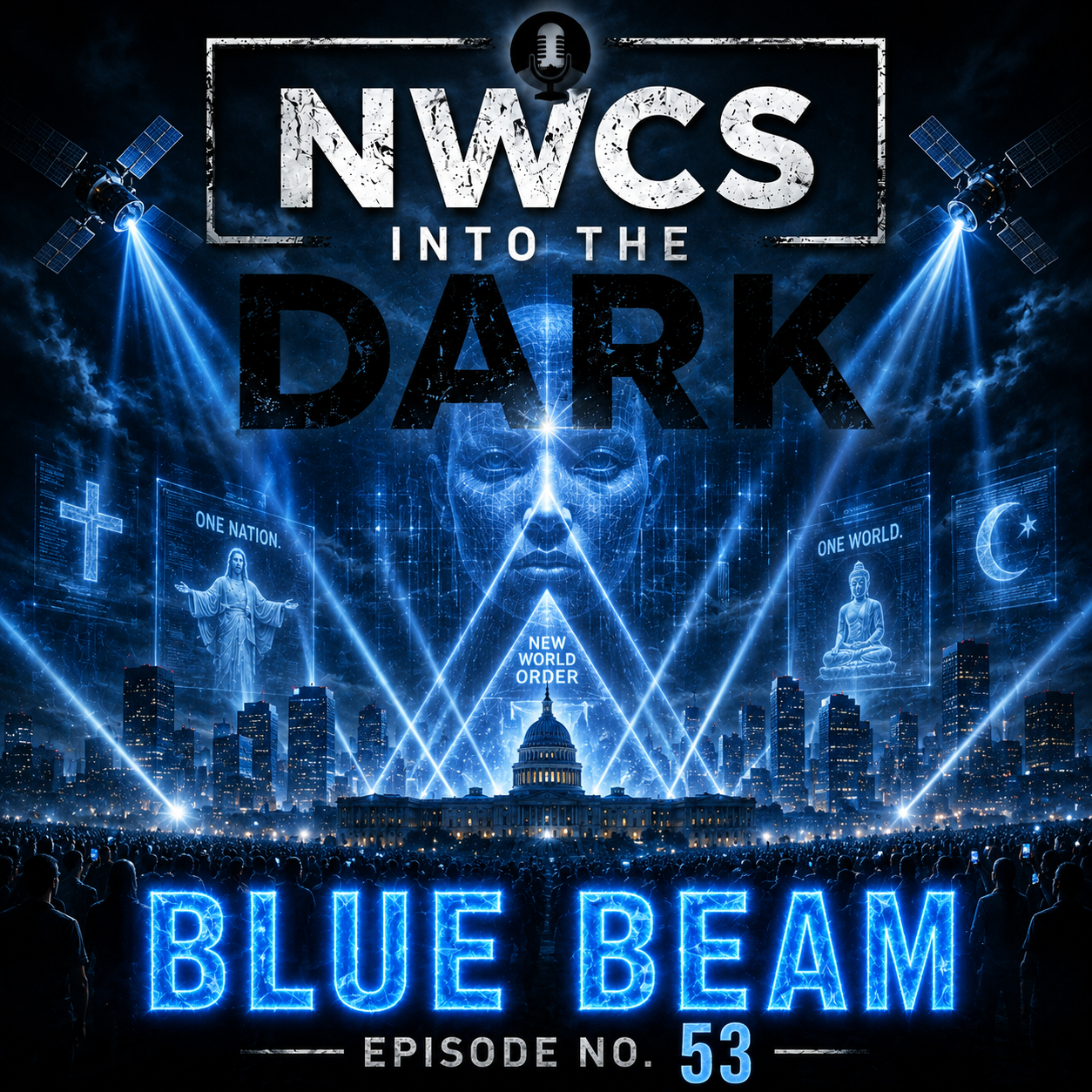
He called it Project Bluebeam.
For decades, it was dismissed as another outlandish conspiracy conspiracy theory.
But today, we live in a world of artificial intelligence, deep fakes, voice cloning, drone swarms, and technology capable of making almost anything appear real.
So was Serge Monast simply a conspiracy theorist?
Or was he decades ahead of his time?
Tonight, the NWCS into the dark Park House is digging into one of the most common controversial conspiracy theories ever created.
Joining me are the usual suspects.
Danny, who's probably more concerned about where we're ordering dinner than whether aliens are invading.
Tab, our resident skeptic, who's here to remind us that extraordinary claims require extraordinary evidence.
Scott, who's afraid of his own shadow, so this episode should go really well.
And Rob, who has an uncanny ability to break just about everything he touches, including, quite possibly, this investigation.
Together, we're breaking down the origins of Project Bluebeam. The evidence, the technology, the theories. And the biggest question of all.
If someone could manufacture the greatest deception in human history, would any of us know the difference?
Let's step into the dark. Hello, greetings, and welcome to NWCS into the Dark podcast.
[00:04:37] Speaker C: Hello.
[00:04:38] Speaker B: In the studio this Evening, we've got Tab Ahoy. We've got Rob with 14 Bs, minus a C. What?
[00:04:45] Speaker D: Wow.
[00:04:46] Speaker B: The B is silent.
[00:04:48] Speaker D: Oh, yeah. Hello.
[00:04:49] Speaker E: Hey.
[00:04:50] Speaker B: And all the way from somewhere mysterious with that background, we've got Danny, as usual.
[00:04:57] Speaker D: Oh, yeah.
[00:04:58] Speaker B: Oh, yeah. Love that. Every time. Love that.
So if you guys were wondering where the rest of our funds went, from our account, they went to the artist for that new intro. What do you think?
$14,000 for that?
[00:05:15] Speaker D: Yeah.
[00:05:15] Speaker B: Yeah.
[00:05:16] Speaker D: That's just chump change for us.
[00:05:17] Speaker B: It was 11 hours of studio time.
Seven. Seven levels of talent.
[00:05:23] Speaker D: Wow.
[00:05:23] Speaker B: Yeah.
[00:05:24] Speaker D: Is that the same as separation?
[00:05:26] Speaker B: Yeah.
[00:05:26] Speaker C: Right?
[00:05:27] Speaker B: Yeah. So this is our first time in the studio for 1.3 years. 1.3 years?
[00:05:33] Speaker C: Has it been that long?
[00:05:34] Speaker B: It's been that long. 1.3 years.
[00:05:36] Speaker D: 3. How many days is that?
[00:05:37] Speaker C: Well, it took several days to dust everything off.
[00:05:40] Speaker B: Right. There was so many. It was like a creepy haunted house. It was cobwebs.
So 1.3 years in the studio. We haven't seen each other since then. I'm sure there's lots of new stuff. Anything new? Anything new with the group? Danny, what do you got?
[00:05:54] Speaker C: Most of the new stuff I want to talk about. I don't want to talk about why. I just don't want to.
[00:05:59] Speaker D: Because it'll get scooped up by Project Bluebeam.
[00:06:02] Speaker B: Right?
[00:06:03] Speaker C: Right. I don't want too much about my personal life out there.
[00:06:09] Speaker D: Well, I'll share one thing.
[00:06:10] Speaker B: Hey.
Oh, no.
Something.
[00:06:17] Speaker E: I didn't start it.
[00:06:18] Speaker B: All right, Danny, go ahead.
[00:06:22] Speaker D: Oh, boy.
Not a conspiracy. Danny is off the market. Danny's getting. Getting hitched here.
[00:06:28] Speaker C: Hitched?
[00:06:28] Speaker D: That's probably the big, biggest dance for me.
[00:06:31] Speaker B: Danny's getting hitched. Danny's getting so Las Vegas. Two little lovebirds sitting in a tree.
[00:06:46] Speaker D: That's probably the newest and greatest and greatest.
[00:06:49] Speaker B: Somebody's putting up with D.
[00:06:52] Speaker D: That's right. That's right. It only cost me, you know.
[00:06:56] Speaker C: Wait, what?
[00:06:56] Speaker D: 50 grand or. I don't know. What was that project? That was Project Bluebeam Down.
[00:07:01] Speaker B: Is she a mail order?
[00:07:02] Speaker C: That's where all the money went.
[00:07:04] Speaker E: It's gonna cost you a lot more than that, buddy, let me tell you.
[00:07:09] Speaker B: What does that mean? This is like his soul.
So is this the same little lady that was on the podcast? No, different. Okay.
[00:07:23] Speaker D: Why would you.
[00:07:29] Speaker E: To this? Probably a fan. She's no longer a fan.
[00:07:32] Speaker B: Like, he's never been with anybody. But this girl that he's with now, is that what you expect?
[00:07:37] Speaker D: He's been saving himself, according to her, you know. Yeah. If you ask.
[00:07:42] Speaker B: So it's not the same girl as last week, Danny.
[00:07:47] Speaker D: Yeah. Considering it's been, what, three and a half years since we've been in the podcast studio, then, you know.
[00:07:53] Speaker C: Yeah, that's true.
[00:07:56] Speaker B: So congratulations. When is the. When is the thing?
[00:08:00] Speaker E: The thing?
[00:08:00] Speaker C: Yeah.
[00:08:01] Speaker D: Yeah. Thank you. Thank you.
[00:08:03] Speaker B: When it. When it. When is the thing?
[00:08:05] Speaker D: November. November 21st.
Yes, sir.
[00:08:10] Speaker B: August. So our August trip that we're going to take, that everyone's already on, so that's going to technically be, you know, our guys. Trips. Bachelor.
[00:08:19] Speaker C: Bachelor.
[00:08:21] Speaker D: Yeah, the northwest bachelor party.
[00:08:23] Speaker C: I'm sure you're having another one.
[00:08:24] Speaker D: How will it be much different than a regular bachelor party, you suppose?
[00:08:28] Speaker B: Well, because the people that you're going to be experiencing the dancing with, they're not alive. Yeah, they're not alive.
It's like climb like Klein in the gold field.
[00:08:38] Speaker D: Then we. Yeah, I'll take it. Did we nail down a location?
[00:08:41] Speaker B: We have not. We need to discuss that in the middle of our breaks for this and the next podcast.
[00:08:48] Speaker D: Where are we going? Yeah, what we're doing, we're running double.
[00:08:50] Speaker B: I've got some ideas. I've got some ideas.
[00:08:52] Speaker D: Yeah.
[00:08:53] Speaker B: Rob, anything new? I see you're over there on Grindr.
[00:08:58] Speaker C: He's trying to get everybody in trouble.
[00:09:00] Speaker E: God, I. I don't understand.
[00:09:02] Speaker D: Did you get three grinds just a moment ago?
What?
[00:09:05] Speaker B: I don't even know what that means.
[00:09:08] Speaker D: Is that the notification sound? You get a.
I don't know.
[00:09:11] Speaker C: Oh, the vibration sound sounds like.
[00:09:13] Speaker D: Yeah, you get a little. A little ringy dinghy in your pocket.
[00:09:17] Speaker C: Little vibe.
[00:09:18] Speaker B: Anything new?
[00:09:19] Speaker E: Yeah, my. My fingernails growing back.
[00:09:22] Speaker B: Oh, your Franken finger came completely off.
[00:09:25] Speaker C: We installed a new sunroof in his rv.
[00:09:28] Speaker A: Skylight.
[00:09:29] Speaker C: Skylight. Skylight, yes.
[00:09:30] Speaker D: Didn't we talk about your finger?
[00:09:32] Speaker E: It's been.
[00:09:32] Speaker D: Or was that a different.
[00:09:33] Speaker E: It was. No, I. It was like. I see. I'm always doing something.
[00:09:37] Speaker B: He's always got Franken finger fingers.
[00:09:40] Speaker C: Well, they're so big.
[00:09:43] Speaker D: What's the story this time? Did you get a. A cadaver like Wavy Davey?
[00:09:47] Speaker E: No.
[00:09:48] Speaker D: You know, Dave had that cadaver replacement in his arm. Oh, that's from the shark attack.
[00:09:53] Speaker E: I forgot about that. Yeah.
[00:09:57] Speaker D: Wow. We got to catch up more, apparently.
[00:10:00] Speaker E: Yeah. But, yeah, no, I really don't have anything exciting to talk about.
[00:10:04] Speaker B: Project Bluebeam. You guys know what that is?
[00:10:06] Speaker C: What's new with Sky?
[00:10:07] Speaker D: Wait, what's new With Scott and Tab.
[00:10:09] Speaker B: Well, I'm just working all the time, man.
[00:10:12] Speaker C: Like, I'm trying to find work.
[00:10:14] Speaker B: I'm just working. Yeah, I'm tired of working.
[00:10:16] Speaker D: Well, I get that.
[00:10:17] Speaker C: It's just been slow. It's the economy.
[00:10:19] Speaker D: Oh, yeah.
[00:10:20] Speaker C: If you're in business for yourself, do
[00:10:21] Speaker D: we still get to say Covid? Is Covid still a thing? Is that.
[00:10:24] Speaker C: I think Covid started.
[00:10:25] Speaker B: Let me tell you something hilarious about that.
So, yeah, I. I don't know if I should mention the radio station, because I don't know where we're going to go with this, but I was in my car the other day and I listened to.
Well, I was listening to a radio station. Like a FM radio?
[00:10:42] Speaker C: Like a talk show?
[00:10:42] Speaker B: No, just like a music.
They had a commercial on there for Covid, and they're like, oh, Johnny doesn't get to play soccer. Oh, poor Johnny.
[00:10:54] Speaker D: He.
[00:10:54] Speaker B: He doesn't have the vaccine. If Johnny had the vaccine, he could play soccer. I was like, are you kidding me?
And this was like, last week.
[00:11:05] Speaker C: What?
[00:11:05] Speaker B: Yeah, I thought that was really weird that it was still like a radio commercial.
[00:11:09] Speaker C: Yeah, don't get me started.
[00:11:11] Speaker D: Do you think this could be tied to Project Bluebeam in some way?
[00:11:14] Speaker B: It's possible. Covid, the big distraction.
[00:11:17] Speaker C: I. I don't know. I wouldn't put it in the exact category, but yeah, that's certainly deception going on.
[00:11:22] Speaker E: I think it's those goddamn aliens.
[00:11:26] Speaker B: I think it's a blue beam.
[00:11:28] Speaker D: It's.
[00:11:29] Speaker C: It's laser.
[00:11:32] Speaker B: Well, speaking of project.
Speaking of Project Blue Beam, it's one of the strangest and most enduring conspiracy theories to emerge from the 1990s. The theory alleges that powerful government and global organizations have developed a plan to manufacture a worldwide crisis using advanced technology, psychological manipulation, artificial religious events, and possibly even a staged extraterrestrial invasion from.
[00:11:59] Speaker D: Oh, my UAPs.
[00:12:00] Speaker E: Well, the moon landing was staged.
[00:12:04] Speaker B: The alleged objective is relatively simple. Create enough fear, confusion, and chaos that humanity willingly accepts greater the loss of individual freedoms and eventually the establishment of some form of global authority. On the surface, the entire.
On the surface, the entire theory sounds like something from a science fiction movie. But more than 30 years after Project Bluebeam was first introduced, something has changed. Artificial intelligence can now create people who don't exist. Voices can be cloned, videos can be manufactured. Government officials can be deep faked. Thousands of drones can move together through the sky. So tonight, we're going to investigate Project Blue Beam. Where the theory came from, who created it, what are the four alleged stages of this operation? And is there any credible evidence supporting it? And perhaps most importantly, did a conspiracy theory from the 1990s accidentally predict the technological world we live in today? That's Project Bluebeam, gentlemen. That's.
[00:13:05] Speaker C: It's alive and well. It is definitely alive and well right now.
[00:13:09] Speaker D: So. So, I mean, all jokes aside, I guess, I mean, some of those column chess pieces fell during certain events in the world, you know, Covid being maybe the most recent. And what was before that?
[00:13:22] Speaker B: Well, at that same. At that same time, you guys might recall that we had those mysterious drones in the sky that nobody could explain.
[00:13:30] Speaker C: Yeah.
[00:13:30] Speaker B: And. And the government. And the government was like, don't worry, we're looking into it.
[00:13:35] Speaker C: Yeah.
[00:13:35] Speaker B: And then you literally never really heard. I mean, it's not like they were trying to deceive us with something like this, but that was going on then.
[00:13:44] Speaker C: Yeah, but they weren't upfront about anything.
[00:13:46] Speaker B: No. And I.
[00:13:46] Speaker C: They acted like nothing was going on.
[00:13:48] Speaker B: And to today, is there anything, you know, like. There's no. People in New Jersey were like, the drones the size of a car were, like, hovering over.
[00:13:57] Speaker C: Yeah, they're just on to the next.
The next.
[00:13:59] Speaker B: But was it real? You know, were those real or was it a projected image? Or.
[00:14:05] Speaker D: What about the balloons? Yeah, the balloons are around the same time.
[00:14:08] Speaker C: Yeah. They let that thing fly all the way across the United States, and then they blew it up over the ocean, over the Atlantic, where they couldn't get any of the.
[00:14:17] Speaker D: Of it back.
Right.
[00:14:21] Speaker C: To study it or see what they were doing with it and lost it in the ocean. It's gone.
[00:14:26] Speaker D: Darn it. It's down there with the Titanic. And.
[00:14:28] Speaker C: Yeah.
[00:14:29] Speaker E: When we get our budget. Our budget back.
I have an idea.
[00:14:33] Speaker B: What's that?
[00:14:35] Speaker E: You could buy a. You could buy a drone that a person could get into. You can get that on temu.
[00:14:41] Speaker C: Yeah.
[00:14:41] Speaker E: I mean, it only. It only flies for like, 90 seconds.
[00:14:47] Speaker D: Isn't that just like an airplane or a helicopter? Basically, it's like.
[00:14:50] Speaker C: It's like a four prop drone, but,
[00:14:53] Speaker B: yeah, I've seen it as like, eight. So, Danny, if we got something like that, you could actually join us for our podcast in person.
[00:15:00] Speaker C: Right. You can take several charging trips.
[00:15:04] Speaker D: Charging real quick. I'll just leapfrog my way up the. Up the West Coast.
[00:15:08] Speaker E: Yeah.
[00:15:08] Speaker C: On a drone.
[00:15:09] Speaker B: Yeah, I would pay.
[00:15:10] Speaker D: You have to put the horses away. When I land, though, do they.
[00:15:14] Speaker B: Do they just put, like, shoulder straps around Danny and then, like, haul him like a big cow, like cattle?
[00:15:19] Speaker D: I just run. Just run and jump like they do
[00:15:21] Speaker B: with Cattle, when they're taking them away from a fire, they put straps around them and lift them up. Here comes Danny.
[00:15:28] Speaker E: Wow.
[00:15:29] Speaker B: Hey, guys. My shoulders kind of hurt.
Yeah. So does anyone know who.
[00:15:35] Speaker D: Let's not forget about murder hornets, by the way.
[00:15:37] Speaker E: Oh, yeah. Remember those big ass things?
[00:15:39] Speaker B: Oh, yeah, I remember that. The fires.
[00:15:42] Speaker C: We should do.
[00:15:42] Speaker B: We should do a podcast just on 2020. Like all the crazy crap that went on during.
[00:15:48] Speaker C: Gosh, yeah.
[00:15:50] Speaker D: I hate to tell you guys, but I think we're doing it right now.
[00:15:53] Speaker C: Yeah, we are kind of, you know, we're.
[00:15:55] Speaker B: We're getting off topic a little bit.
Oh, I just. I'm just saying I just thought of something that was like, fleeting, really. Good point. And then it flipped right out of my.
[00:16:05] Speaker C: It's called old age.
[00:16:07] Speaker B: Oh, man, that sucks. Oh, oh, NASA. Like with the. The fake.
[00:16:12] Speaker E: Oh, NASA.
[00:16:13] Speaker B: The fake flights.
[00:16:14] Speaker E: Yeah, but NASA introduced a ufo.
[00:16:18] Speaker B: Or you uap.
[00:16:20] Speaker E: Uap.
[00:16:23] Speaker D: Phenomenal.
[00:16:25] Speaker B: Anyway, yeah, yeah, fake NASA stuff. So what, like the.
[00:16:29] Speaker C: The moon, this last moon trip?
[00:16:31] Speaker B: I'm not necessarily saying this last moon trip. I'm just saying that a lot of the stuff that you see where they're like, hey, we're in space, and then they, you know. Oh, yeah, drop a ball and it falls to the ground. Or you, oh, we weren't ready yet. Yeah. Or you see some guy hidden in the corner taking a drink of water.
[00:16:47] Speaker D: Yeah. I don't know why.
[00:16:48] Speaker B: I don't know why they feel the need to do that.
[00:16:50] Speaker C: I know, but, you know, with the age of AI, I mean, how much of that stuff is fake to make it look fake.
[00:16:56] Speaker B: Right?
[00:16:57] Speaker C: You know?
[00:16:57] Speaker D: Yeah.
The world is flat.
[00:16:59] Speaker C: I'm sure there's ways that they can do these things with getting past the AI detectors that they have. I can usually tell.
[00:17:07] Speaker B: So what are your guys's thoughts on. On Project Blue Bean? Danny? Anybody? I guess we need to figure out who Serge Monaster is first.
[00:17:14] Speaker C: Yeah, Canadian guy.
Canadian.
[00:17:19] Speaker B: Who was Sergey.
[00:17:21] Speaker D: Yeah, who was Serge? Tell me to tell you about him.
[00:17:24] Speaker B: Tell me about him.
[00:17:25] Speaker D: I'll tell you about him. The. The project.
By the way.
[00:17:29] Speaker B: By the way, we love our Canadian listeners. Yeah, that's what we're all about.
That's what we're hearing.
[00:17:35] Speaker D: We love our listener. We love that listener.
[00:17:38] Speaker B: That's what we're all.
[00:17:39] Speaker C: Not one.
[00:17:40] Speaker D: One guy run about.
And it wasn't me this time. Do you want me to tell you about search?
[00:17:45] Speaker B: Yeah, I can tell you a little bit.
[00:17:49] Speaker D: So this. This Project Bluebeam theory was popularized during the 1990s by Canadian journalists and Conspiracy theorists, Serge Monist. Monist claimed that NASA and other powerful organizations were developing a four stage operation designed to manipulate humanity on a global scale. But before investigating whether Project Bluebeam is real, there's a much more basic question that needs to be answered. Was Serge Monast a credible source? Where did his information come from? Did he have have sources inside the government? Did he possess classified documents? Was he uncovering something real? Or was Project Bluebeam simply an elaborate conspiracy theory built around existing fears involving technology, government power, globalization and the loss of individual freedom? From an investigative standpoint, these questions are extremely important. Before evaluating rather an extraordinary claim, we first have to evaluate the person making it.
[00:18:49] Speaker B: I think he might have been mentally ill.
[00:18:51] Speaker C: Okay, what?
[00:18:52] Speaker B: Because, because the research that I did on him said he spent some time in some place called the Waverly Sanitarium.
[00:19:00] Speaker D: Really? Oh, wow.
[00:19:01] Speaker B: Yeah.
[00:19:02] Speaker C: So he had tv.
Okay, well, when you hear the term Project Bluebeam, what is the first thing you think of as a side of. He said Bluebeam, what's the first organization you think of?
[00:19:17] Speaker D: That I think of?
[00:19:18] Speaker C: Yeah. If you knew nothing about.
[00:19:20] Speaker B: Sir.
[00:19:20] Speaker D: NASA.
[00:19:21] Speaker C: You think you think of NASA?
[00:19:22] Speaker B: Yeah, I kind of think of NASA.
[00:19:24] Speaker E: I mean that's what is.
[00:19:26] Speaker C: I think of the CIA. I mean, what a perfect thing for them to have because they're just built on.
[00:19:32] Speaker B: So this, this, this theory has obviously been around since the 1990s. It's gained a lot of traction coming up until fairly recently when people were like, hey, that could actually be a thing.
But why? If this guy's coming out, Serge comes out and he's like, I've got all these leaked documents. Well, where are the documents? Like I've tried, yeah, I've tried to find it. If what you're saying is, why wouldn't you just say these are the leaked documents?
[00:20:00] Speaker D: Right. Well, did they have links back in the day in 1990?
[00:20:03] Speaker B: Sure they did.
[00:20:04] Speaker C: They had those little tiny cameras. He could have taken small photos, he
[00:20:08] Speaker D: could have made a copy cams.
[00:20:10] Speaker C: He should have made a copy of
[00:20:11] Speaker B: the teletype that it came through.
[00:20:13] Speaker D: Microfilm.
[00:20:14] Speaker B: Yeah, microfiche.
[00:20:18] Speaker D: But I think that's been the biggest claim against, is that he really hasn't produced any evidence. Right. It's a lot of claims, no evidence.
[00:20:26] Speaker B: Right. But I don't think that you really need that because it, I mean it truly sounds like something the government would do. Let's deceive all the stupid people. We're going to make a holographic image of Jesus in the sky. Tell her when the sky is falling
[00:20:40] Speaker C: and Then do you remember the story that came out of Florida where they said that these giant aliens were walking among this? You know that was in the mall. At the mall in Florida.
[00:20:52] Speaker B: Yeah, yeah.
[00:20:52] Speaker C: Out in the street.
[00:20:53] Speaker B: Yeah. And then.
[00:20:54] Speaker C: And the only pictures were like from a helicopter. And it could have been just two people walking side by side.
[00:21:01] Speaker B: Right. I don't think, I don't think.
[00:21:03] Speaker C: But it got such a big story on the news.
[00:21:06] Speaker B: I don't think that it got a big story on the news. I think it got a big story on the Internet.
[00:21:10] Speaker C: Well I, there was news stations covering it and that's where I get into the CIA. Thing is because they're all linked together,
[00:21:20] Speaker B: I've seen that and I totally feel like if it happened at a mall two years ago with that many people there would be tons of cell phone, totally cell phone video. And from what I saw of that video there was like hundreds of cop cars out front.
[00:21:36] Speaker D: Right.
[00:21:36] Speaker B: That means hundreds of officers with body cams.
[00:21:39] Speaker E: Yeah.
[00:21:39] Speaker C: And I guess the official story was fireworks or something like that just caused mass.
[00:21:44] Speaker B: But yeah, I don't buy that one at all.
[00:21:46] Speaker C: It's not that I buy it, not that I buy the story. It's just that it got a lot of coverage.
[00:21:53] Speaker B: Right.
[00:21:54] Speaker C: A deception, you know, let's see what we can get away with. How ridiculous of a story we can come up with and how many people will believe it.
[00:22:01] Speaker B: Yeah, like a virus that.
[00:22:03] Speaker C: Right.
You know, the common cold. Let's see how.
[00:22:10] Speaker D: Yeah.
Will Smith and Tommy Lee Jones came down and flashy thinged everyone. I think so.
[00:22:15] Speaker E: Yeah.
[00:22:16] Speaker B: So what are the, what are the four stages of that Project Bluebeam. Danny?
[00:22:20] Speaker C: Love it.
[00:22:21] Speaker B: Oh, we need to, we need to break, we need to break down how this works and then we'll talk about it, then we'll analyze kind of how it works. So there's four, there's four stages to this Project Bluebeam and this great, the great deception that it is.
[00:22:37] Speaker D: Let's start with step one, or stage one rather. According to Monast, the first stage of Project Bluebeam would involve artificially created earthquakes that would reveal previously unknown archaeological discoveries. Archaeological even these discoveries would supposedly contradict existing religions beliefs and challenge humanity's understanding of history. Harp the objective, the objective would be to create confusion and destroy people's confidence in traditional institutions and belief systems. Once people began questioning everything certain previously believed it would become more. More willing to accept an entirely new version of reality. Could something like that actually work? Yeah. Could archaeological discoveries genuinely change global religions beliefs? Could historical evidence be manufactured and Perhaps most importantly, how difficult would it be to convince billions of people that everything they believed about their history was wrong?
[00:23:35] Speaker B: I think it would be super simple.
[00:23:37] Speaker C: Yeah, you just stop teaching history altogether. And the schools are just failing. Kids don't even have to at least hear in Oregon, they don't even need to know how to read.
They don't need to know how to write, and they don't need to do math, you know, and they still get a diploma.
[00:23:51] Speaker B: I think that they could. And here's. Here's a perfect example. Why is, you know, this question. Everything kind of freaked people out. I had a momentary loss of my mental acuity when the drones. When that whole Jersey drone thing was going on.
There was such a big story and there were so many videos of it and everybody was freaking out that I actually, like, at night was having, you know, a drink or something before bed or whatever. I was on the porch and I would see these lights and they were clearly airplanes. But I started freaking out, and then I would see these flashing lights on the mountain that's not far from here. I'm like, those are drones coming down to the. The mountain. I think that it's very easy to. What do they call that when they heard, you know?
[00:24:36] Speaker C: Well, you definitely catch yourself doing what you normally don't do, like look up all the time, you know, and so now you're noticing things that you normally wouldn't because you're usually looking at. Everybody's looking on their phones or.
[00:24:48] Speaker B: Yeah, I think. I think it would be super simple today to deceive people. Really simple.
[00:24:54] Speaker D: Yeah. What if in stage one, they talk about, you know, he talked about an earthquake. But what if that's really metaphoric meaning, you know, the objective of stage one is really about to create confusion and destroy your confidence in tradition and beliefs. Right. So metaphorically. Maybe we don't see a giant earthquake that exposes something, but there's something that causes you to. To shake and question your foundational beliefs that have been there for years, your whole life, maybe even.
[00:25:22] Speaker B: What about. What about something like those.
Those tabernacle horns that are heard, you know, that freaks people out. There's just these.
Heard about those things, those horns that play and they. They sound kind of like tabernacle horns.
[00:25:35] Speaker E: Yeah. Didn't we do it?
[00:25:37] Speaker D: Did we do a. I think we did a guest. That sound on it.
[00:25:40] Speaker E: Yeah.
[00:25:41] Speaker B: So you can just pump noises out and just noise and loan is enough to make people kind of freak out.
[00:25:47] Speaker C: What is that?
[00:25:48] Speaker B: Is Jesus is coming? Because it's the horns of the trump.
[00:25:51] Speaker C: The trumpet sounds.
[00:25:52] Speaker B: Yeah, the trumpets.
[00:25:53] Speaker D: Yeah.
[00:25:54] Speaker B: Jesus must be coming. Those trumpets are coming from the sky. You know, like people freak out over, over little. You kind of lose your mind a little bit.
[00:26:02] Speaker E: Yeah.
[00:26:02] Speaker C: But here we go again. We got this confusion with AI.
[00:26:06] Speaker D: Are we.
[00:26:06] Speaker C: What are we seeing now? I mean, I'm starting to see these Bigfoot videos that are very convincing now after AI.
[00:26:14] Speaker E: Yeah, he's eating beef jerky now.
[00:26:16] Speaker C: Well, like it's crazy.
[00:26:19] Speaker E: Sorry, that's commercial.
[00:26:22] Speaker D: And taking showers with bars of soap.
[00:26:24] Speaker C: So I have a hard time believing what I'm seeing, even though it could be real.
[00:26:28] Speaker E: Yeah.
[00:26:28] Speaker C: So now you've got this AI Deepfake stuff going on. And now they can either introduce something that's real to us and we won't react the same. Our reaction is more muted, it's more benign.
[00:26:40] Speaker D: Questioning foundation. You're questioning the foundation in tradition.
[00:26:44] Speaker C: Right, Right.
[00:26:45] Speaker D: Maybe. Maybe we're squarely in the middle of stage one. Or I suppose, let's see what stage two is.
Anyone want to take on stage two?
[00:26:53] Speaker E: Stage two? Yeah, sure, I'll read it.
Stage two is the second stage is the most famous element. The Project Bluebeam conspiracy. According to the theory, advanced technology would be used to project enormous three dimensional IM into the sky. Different populations around the world would allegedly witness different religious figures and events based upon their cultural religious beliefs. Christians might see Jesus. Other pop populations would witness figures associated with their own religious traditions. Eventually, these separate images would merge into a single new global religious figure. What would that look like?
[00:27:35] Speaker B: A little bit like Buddha.
[00:27:37] Speaker E: Buddha with a beard and sandals.
When Manas introduced this theory during the 1990s, the ideas sounded almost ridiculous. The technology simply didn't appear to exist. But today, the conversation is slightly different. We now have drone swarms, advanced projection technology, augmented reality, artificial intelligence. That's a big one right now. Deep fakes, sophisticated visual effects, and increasingly advanced military deception systems. None of these technologies prove that Project Blue Beam exists. But they still. But they do raise interesting question. Has technology, has technology finally begun catching up with this conspiracy?
[00:28:26] Speaker B: Yeah, you can take swarms of drones and do some pretty amazing, crazy, pretty amazing things.
[00:28:31] Speaker C: Okay, so here we go. This is all kind of playing out. This is all kind of playing out. I mean, is he, you know, a prophet?
[00:28:40] Speaker E: Nostradamus?
[00:28:41] Speaker C: No, this Surge guy. Yeah, no, he's seeing it happen before it happened before the technology.
[00:28:47] Speaker B: Yeah. Maybe he's just disguising it under a. Oh, I have some leaked documents, but he's trying to get the information out there.
[00:28:54] Speaker C: Stage three Is voices in your head. This is going on right now, you know, with the microwave weapons that they, they have.
[00:29:01] Speaker D: Again, go ahead.
[00:29:02] Speaker C: No, no, no, go ahead. I'm just putting it out there. I'm jumping to phase three.
[00:29:06] Speaker E: Yeah, go ahead.
[00:29:08] Speaker D: I was just gonna say maybe that's what it would look like. What if again, metaphorically, it isn't necessarily that it's broadcast in the sky. Right. It's, it's, it's kind of metaphoric, but there is this a. This, this method of broadcasting on a large scale. A new.
Lack of a better word, deity. Right. There's this new. He focuses a lot on religion. It sounds like, you know, this, this is saying that this new global religious figure. Right. Religious, I think in this context just means that it's something that people are putting faith into. Right, right. And it could still be, it could still be something that's more non religious in the traditional sense, but quantum they. Right, right, right. And the. In the phase one, you're shaking that foundation. In phase two, you're, you're finding a new deity, as it were, religious figure in a way that everyone is kind of getting behind to deliver this new message. Right?
Yeah. So, yeah, I mean, I don't know that necessary needs to be a broadcast in the sky in that way. It could be these phones in our pocket.
[00:30:21] Speaker C: Well, they're starting to put chips in people's heads. Granted they're, you know, they disability and it's for good reasons, but eventually might not have these phones in our pockets and we'll just have the phone in our head.
[00:30:32] Speaker E: Yeah.
[00:30:33] Speaker C: And then look how easy it'll be. I mean, you could talk to the masses.
[00:30:36] Speaker E: You could put a debit card in your wrist.
[00:30:39] Speaker C: Right.
[00:30:39] Speaker E: Go up and scan.
[00:30:40] Speaker B: But that's, that's the mark of the beast right there. What about.
[00:30:44] Speaker C: Well, that's just a meta. That's just a metaphor. I mean, so what about this?
[00:30:48] Speaker B: It's even, even as far back as 1990 when he's saying, you know, this, this alleged conspiracy theory. This is kind of how you can. If you guys remember going back to the 80s, I mean, I know Max Headroom was sort of a character.
[00:31:03] Speaker C: Yeah.
[00:31:04] Speaker B: But there was in the 1980s where these transmissions would come over, like news broadcasts.
[00:31:11] Speaker C: Yeah.
[00:31:11] Speaker B: And.
[00:31:11] Speaker C: Yeah. Pirate stations.
[00:31:13] Speaker B: And that like totally freaked people out.
[00:31:16] Speaker C: Well, they tried to pull off as Max Headroom as being an artificial intelligence at first.
[00:31:21] Speaker B: Right.
[00:31:21] Speaker C: That's how I remember. If I remember right. Unless that's my.
Yeah, mon, you know, Mandela effect. I remember it. They were trying to Play him off as.
[00:31:29] Speaker B: Yeah.
[00:31:29] Speaker C: As an artificial intelligence. That he wasn't real at all.
[00:31:31] Speaker B: Right.
[00:31:32] Speaker C: But it wasn't.
[00:31:33] Speaker B: Right. And they were, you know, I mean, going back even then to the 80s, there was ways to freak people out by interrupting broadcasts with these Max Headroom type.
[00:31:42] Speaker E: Yeah. People.
[00:31:44] Speaker C: Yeah.
[00:31:44] Speaker B: But with technology that we have now, it's even, even more crazy.
[00:31:48] Speaker C: Pretty weird.
[00:31:50] Speaker D: Yeah. I suppose. It doesn't have to be necessarily a person, but a belief. Right. Shake the original foundation, establish a new belief system.
[00:31:58] Speaker C: Well, who knows that this message couldn't be just personalized for every individual? I mean, they're doing that with ads on your phones. It doesn't have to be one message. It could be a million different messages targeted to each individual. How they would respond, but get the same response out of them, you know.
[00:32:17] Speaker D: Right.
[00:32:17] Speaker C: Just in a different way, a different belief structure, all of that.
[00:32:20] Speaker D: Yep.
[00:32:20] Speaker B: So that's stage three, voices in your head.
[00:32:22] Speaker D: Yeah.
[00:32:23] Speaker B: Which brings us to stage four.
[00:32:26] Speaker D: Well, let's, let's, let's, let's examine stage three a little bit more.
[00:32:30] Speaker C: Okay.
[00:32:31] Speaker D: Because I don't think, even though what I hear him say is these specific things that would potentially occur. Right. But I think, I think they're more metaphors within stage three. There's, there's. The voices in your head are, in my mind, is a metaphor for new belief systems. System. Right. It's, it's, it's the, it's the message from the new.
I keep using the word. Right. I don't know what else to say. Right. It could be. It could be seen as the voice of God. It could be seen as a religious figure, but it could be, you know, a secular thing too. I would think so. It's, if you think about it in progression, not in the belief.
[00:33:09] Speaker C: Not everybody's religious. It's not like.
[00:33:11] Speaker D: Right, right.
[00:33:12] Speaker C: Like the old time, you know, old ages. You know, a lot of people don't believe in God or any of that. So they're going to have to reach those people in completely different way.
[00:33:22] Speaker D: Exactly. And I think it's just establishing again, this new thing that. And again it could be. I don't even think it has to be like a traditional sense of a God or religious figure. Right. It could just be a new, true north, a new level of trust. And then now we're getting the message. Right. The voices in the head are the message being delivered to believe and think a certain way and create alignment. Create influence.
[00:33:47] Speaker E: Yeah. Well, clearly people hear voices in their head, like maybe just their interpreter, internal voice, like you're thinking.
You're thinking to yourself.
[00:33:56] Speaker C: But, you know, and there are some people that don't.
They don't hear speech.
[00:34:01] Speaker E: Well, that's. I've never heard of that.
[00:34:02] Speaker C: Some people don't see color.
[00:34:03] Speaker E: Yeah. Well, again, I think that people hear these internal voices and interpret that as God speaking to them.
[00:34:12] Speaker B: Wow. What about. This is off topic a little bit, but I saw something interesting and doing some research that I thought was.
[00:34:20] Speaker C: We're on stage three, Scott.
[00:34:21] Speaker B: I don't know if it's true, but apparently there's a group of people out there that don't have an internal dialogue.
[00:34:28] Speaker E: Yeah, that's.
[00:34:29] Speaker B: Is that true?
[00:34:30] Speaker E: That's what Tab was just saying.
[00:34:31] Speaker C: Yeah. I mean, would that be like autism in a way?
[00:34:35] Speaker B: Like, we all have thoughts in our mind throughout the day. Thousands of times a day, I'm going to do this. Or those are thought. But there's a section of the population that doesn't have any of that internal dialogue.
[00:34:49] Speaker E: That's be. That's just weird to me.
[00:34:51] Speaker B: I don't think it's true. But there was people that were like, that's weird. You do have dialogue. Like, you have thoughts in your head.
[00:34:57] Speaker C: But I think. I think what it is is they. It's just not like they're talking to themselves, you know? You know, in their head. They just are able to do without.
[00:35:06] Speaker D: They just do.
[00:35:07] Speaker C: Having.
[00:35:08] Speaker B: I'd like to.
[00:35:09] Speaker C: They just do the.
[00:35:10] Speaker B: Do.
[00:35:10] Speaker E: I definitely know some people that talk without thinking.
[00:35:14] Speaker D: There isn't. There isn't.
[00:35:15] Speaker B: Why are you looking at me?
[00:35:17] Speaker D: Just a discernment of consequence. Right, Right, exactly.
[00:35:21] Speaker B: I. I would love to, like, legitimately find somebody who claims that they don't have any sort of internal d. I. I don't think it's true. I don't think. I don't think it's. As human beings. I don't think it's possible to say, like, brain dead.
[00:35:35] Speaker D: No, I think it's true. I don't think everything is intention. I think that. I think that. What's the new term? Neurotypical people discern.
[00:35:44] Speaker B: Wow. Look at Danny with a big freaking word.
You've been working in the hospital.
[00:35:52] Speaker D: Yeah.
[00:35:53] Speaker E: Golly, you're smart.
[00:35:57] Speaker D: But I do think there are those people who don't think about the consequence of an action.
[00:36:01] Speaker C: Right.
[00:36:01] Speaker D: And respond to those intrusive thoughts.
[00:36:04] Speaker C: We all have our.
[00:36:05] Speaker D: Our own to. Yeah.
[00:36:06] Speaker C: We all have our own interpretation of reality.
[00:36:10] Speaker D: Right.
[00:36:10] Speaker C: You know.
[00:36:11] Speaker D: Right.
[00:36:11] Speaker C: My reality is different than your reality.
[00:36:13] Speaker B: Yeah.
[00:36:13] Speaker E: And how do you Ye.
[00:36:16] Speaker C: Well, it's true.
[00:36:17] Speaker D: Have you ever thought about that who's it shouldn't be, though. This is interesting. Have you ever thought about that? I'm gonna take us down a rap trail. Who's reality.
[00:36:24] Speaker C: I'm sure I've been down that trail. So our realities are probably pretty similar.
[00:36:28] Speaker D: Whose reality is the truth? There can only be one real reality.
Really?
Yeah.
[00:36:34] Speaker B: Why does Danny look like he's got so many big standing behind his.
[00:36:38] Speaker C: Well, then you get into multiverses.
[00:36:40] Speaker D: Don't worry about that little guy. Don't worry about that little guy.
[00:36:43] Speaker C: Then you get into multiverses.
[00:36:44] Speaker B: Can you see it, Danny?
There's like a man.
[00:36:47] Speaker D: It's probably my dog.
[00:36:48] Speaker B: There's a man in a plaid suit standing behind you. It's like shoulders come up.
[00:36:52] Speaker E: That's his chair.
[00:36:53] Speaker D: It's. Yeah, I have. My jacket is on my chair. Oh, it's. It's blue and black plaid.
[00:36:58] Speaker B: That's screwing up your green screen.
[00:37:00] Speaker C: Is it a blue screen or a green one?
[00:37:02] Speaker D: Yes.
[00:37:03] Speaker B: Sorry, did I cut you off?
[00:37:05] Speaker E: Yeah, absolutely.
[00:37:06] Speaker D: Reality you're talking about.
[00:37:08] Speaker C: It's both.
[00:37:08] Speaker D: Is there only one reality or are there multiple realities?
[00:37:13] Speaker C: Yeah, that's a.
[00:37:13] Speaker A: A.
[00:37:14] Speaker C: That's.
[00:37:14] Speaker D: That's.
[00:37:15] Speaker C: That's going way into a deep, deep, deep, deep.
[00:37:20] Speaker B: Rabbit.
[00:37:20] Speaker C: That's another episode.
[00:37:22] Speaker D: Do I exist in your reality or do you exist in my reality?
[00:37:25] Speaker C: Right.
Or how many realities? Yeah, yeah, yeah.
[00:37:30] Speaker D: Once they unplug me from the Matrix, then I'll. I'll be able to tell you.
[00:37:34] Speaker B: And that, my friends, brings us to stage four of this. Are these really stages of this methodical evil? Yeah, which is to create global chaos. And the final stage of Project Bluebeam allegedly involves manufacturing a worldwide crisis.
[00:37:52] Speaker C: Again, we're right in the midst.
[00:37:54] Speaker B: The exact nature of the virus varies. I mean, crisis varies depending upon different versions of the theory. Some involve a staged extraterrestrial invasion. Others involve supernatural events, a religious apocalypse, or global military conflict. Regardless of the specific scenarios, the alleged strategy remains the same. Create the problem, generate fear, offer the solution. Governments declare emergencies. Military forces mobilize populations panic, civil liberties are suspended and financial markets collapse. And eventually, some form of global authority offers humanity protection. According to the theory, people would willingly surrender freedoms they would never surrender under ordinary surv circumstances because they had become convinced that the alternative was destruction. Well played, Serge Monast.
Well played.
[00:38:49] Speaker D: This strikes me as awkwardly coincidental or strange that it aligns with the theme of early Marvel movies in the Avengers suit of armor around the world.
[00:39:02] Speaker C: Yeah, that's true. He could have been just reading a comic book and those were his documents.
Yeah, can we find some comments that touch the. The reading of the minds or voices
[00:39:14] Speaker B: in the head and yeah, does anyone know?
So I did a little bit of research to determine whether or not there actually was a Serge Monast. Like is he real? And apparently he was. The information that he provided to the media was real. And he died December 1996 at the age of 51.
Pretty young. In Quebec, Canada.
The official reported cause of death was heart attack at 51.
His death, yeah, his death has itself become part of the mythology surrounding Blue Beam and there's very two very different narratives.
The official account was that Monas died of a heart attack in December 1997. There's no public publicly available evidence showing he was murdered or that his death was connected to his writings. The conspiracy narrative within conspiracy circles there's several claims are often being repeated that he was allegedly harassed by Canadian authorities because of the investigation that he did regarding Project Bluebeam. Some writers claim that his children were temporarily taken by authorities case over homeschooling issues. Others alleged he was silenced because he was getting too close to exposing Project Bluebeam. And some even claim another researcher died under similar circumstances.
Obviously none of that stuff has been independently verified. And then of course the biggest question did Serge Monast ever produce evidence of these leaked documents? And when you examine the historical records the answer is no. No authenticated Project Bluebeam documents have ever surfaced. And the theory is primarily based on Monast writings and lectures rather than leaked government records or corroborated whistleblower testimony. So he was a real person. He went around and talked about this. In fact I think I saw a video of him talking at like a university or something.
But yeah, he died of a heart attack at 51. Seems awfully young to be dying of a heart attack attack. But yeah, so where, where, you know, I mean he goes around and he lectures and he's trying to get people to believe him. You know, you come out with this crazy conspiracy theory based on leaked documents but where are they? Why not ever produce them? Is your. Not is, you know, if, if it's self preserving and you're going to say I don't want to produce them because you know, well what was this? NASA is going to kill me.
[00:41:43] Speaker C: What's his motive to let, let people
[00:41:45] Speaker B: know well what's, what's people's motives to say that Bigfoot exists, that they saw Bigfoot when they didn't or, or UFOs? It's just notoriety to some degree I would imagine. 15. Everyone wants their 15 minutes of fame that would be my, my thought on that. Yeah, I don't know, but it's very clever. I mean, in, in the various conspiracy theories that we've looked at and, and researched, I think this one seems the most almost plausible. Right, that the gov. That the government would have to resort to these very specific stages.
And I think at the end of the day, if we, if we look at this, I think it's very possible that if they did a good job of doing those four stages, they probably convince people to, I mean case in point, like, look how people. You know, I don't want to keep bringing up Covid.
[00:42:34] Speaker C: Well, let's bring up a different. Let's bring up another event. How about mk. Oh, Ultra or, or a virus that got out. We would have never have known that. But it got out because somebody had. They didn't get rid of all the documents and it was leaked on accidentally. And, and that thing, that was a crazy, crazy thing that the CIA did with mind control.
And so maybe this, this Project Bluebeam, they managed to get rid of all the documents. So we will never know if it was real or not. There's nothing to leak, right?
[00:43:07] Speaker E: Yeah.
[00:43:08] Speaker D: Who, who is the they behind the objective?
[00:43:11] Speaker B: Well, that was NASA. From what I understand. They were leaked NASA documents and I just don't know why NASA, I mean,
[00:43:20] Speaker C: it's just, it's black money. I mean it's black, you know, black projects. They're in the shadows.
[00:43:26] Speaker D: These are projects NASA.
[00:43:27] Speaker B: Right. I feel like he should have said leaked government documents instead of saying. But in, in all theory, if, you know, if you want to say is he telling the truth or is he lying? Why would he lie and say NASA and not, well, CIA.
[00:43:40] Speaker C: Did he believe about, did he believe the moon landings?
[00:43:42] Speaker B: I don't.
[00:43:43] Speaker C: Maybe had a personal grudge against them because he believed that they weren't, they weren't real. I don't know, I'm. That's just a guess throwing that out there.
[00:43:52] Speaker E: Interesting theory.
[00:43:53] Speaker D: Do you think there could be a new intention to create or make another run at it, so to say. I'm thinking about these recent stories of the scientists, researchers, engineers that have gone missing over the last few years or so.
And, and there's ties, if I'm not mistaken, to NASA or Defense or. Right. Aerospace, things like that.
[00:44:17] Speaker C: Yeah, I can't remember the lady about the lady, the lady's name, the anti gravity scientist.
And she was complaining about headaches and stuff. And then we get back to those voices in the head. They were like microwave weapons and people believe that, that, that killed her.
[00:44:33] Speaker B: I mean, look, look what they were able to do all the way back in 1938 when Orson Welles came out with the War of the Worlds. And in the advertisement of that movie in 1938, they did commercials for the movie that were like, there's this alien invasion that's happening. And everybody believed it and freaked out because a few news channels reported, you know, this alien invasion. So it's really easy for media to, to influence public perception, especially today, you know, with social media and AI and fake, fake live streams, deep, deep fake politicians, all of that stuff. It would be very easy to do. They did it in 1938 with very limited to know technology.
They didn't have to, they didn't have to project anything into the sky. Nobody saw these UFOs in the sky in 1938. It was just a radio ad that said, take cover. It's an alien invasion. And everybody lost their mind, you know.
[00:45:31] Speaker C: Well, can you imagine listening to that story, the way that it was presented in and coming to the channel in towards the beginning, but not at the beginning, and then go, what is that? Is not. Have any idea that it was from a book or so? Yeah, I could totally see that happening.
[00:45:48] Speaker D: Interesting. Well, maybe someone's taking a run at it again to get us, get us going again. But yeah, I still question who is the they? Right? Who is the person? Who is the, who is the main actor?
[00:46:00] Speaker C: And I don't think it's one person. I think it's. Yeah, a group. Illuminati, A group of people with the same ideology that, that they are them and we are we. You know, they, them, they, thems.
[00:46:16] Speaker E: Okay, now we're really off.
[00:46:17] Speaker D: Interesting.
[00:46:18] Speaker C: What about you, Danny? Let's say you.
[00:46:21] Speaker D: Well, you know, I guess one could get into that whole, you know, idea of the deep state, the, the action steps, the plan outlined in the stages. Makes sense. I'd be willing to say that that came from, to your point earlier, tab. Maybe some sort of trade craft. Right? This is how you, this is how you manipulate a society. Right, exactly. And could it work? You know, at what level or what scale could that work on? I think you could, because we're human. I think you could get away with that on a larger scale, globally. I don't know. That's, that's tough. And it's. I think the tough part becomes the intentions of the actor or actors that are, that are pulling the, pulling the strings. Right. How do you.
[00:47:04] Speaker C: Well, economically, the world. What's the objective the world, economically, the world Relies on the dollar, you know what I mean, as far as an economy. And so I think therefore, that's where what's uniting us is the world is concerned.
[00:47:18] Speaker D: Right. You know, it's a good point. You follow the money. Yeah, exactly. Find the power, you find the truth.
[00:47:26] Speaker C: Yeah.
[00:47:26] Speaker D: So we're all just become forensic accountants and we'll solve this puzzle.
[00:47:31] Speaker C: There you go.
[00:47:32] Speaker D: Project Blue Beam.
[00:47:34] Speaker B: I was trying to find the original 1938 radio announcement.
[00:47:38] Speaker D: Oh, war of the world.
[00:47:40] Speaker B: War of the world. But they're all like 58 minutes long.
[00:47:43] Speaker C: Yeah, it's like an hour long, I think.
[00:47:45] Speaker D: Yeah, I think, I think though that, you know, you just. On that point. Right. The story. Right. The message was delivered. It wasn't a broadcast in the sky, sort of saying, unless you want to argue airwaves. But the foundation, the traditional beliefs were shaken. And this has all happened in one story. Right. They move through those steps in a very fast way.
[00:48:04] Speaker C: 55 minutes and.
[00:48:05] Speaker D: Yeah, exactly. They shook people's beliefs. They established the. Basically the fear or the worry that, you know, you need to follow this person to help. You planted a new narrative and then took control. Right, right. It just seems to me like a pretty straightforward. It's not surprising that's the game plan to manipulate human.
[00:48:26] Speaker C: So what year was that again, Scott?
[00:48:28] Speaker B: That was 1939. 38.
[00:48:31] Speaker E: 38 or 39.
[00:48:33] Speaker B: Yeah. 1938.
[00:48:34] Speaker C: Could that have sparked this whole. Hey, he's on to something.
You know, this gives me an idea.
[00:48:41] Speaker E: It certainly would look how quickly we
[00:48:44] Speaker C: can just turn a switch on or off. Just.
[00:48:47] Speaker D: Yeah, yeah, I've had that. I mean, you think about it now. Everything's a story, right?
[00:48:53] Speaker C: Yeah.
[00:48:53] Speaker D: Even. Even our interpretation of what's being said is a story for the individual.
[00:48:58] Speaker C: Exactly.
[00:48:59] Speaker D: And if we believe it strongly enough, it's true.
What right or wrong?
[00:49:04] Speaker C: Unfortunately, there's probably more lies out there than truth.
[00:49:08] Speaker D: Yeah, yeah. As strong willed as I think we want to say we are, and as. As, you know, much autonomy that I want to say. We have humans trying to simplify the world and. And you know, it's easier to follow sometimes than kind of step out front. That makes sense. Right. Especially when the group's doing. And you see that in studies.
[00:49:27] Speaker C: Yeah.
[00:49:30] Speaker D: I start to question whether or not I'm right or wrong or what my belief is, you know, right sometimes to our own detriment.
[00:49:38] Speaker E: True.
[00:49:39] Speaker D: We are silly creatures. Do you ever think we're the dodos? Maybe humans are just the dodos. I don't know.
[00:49:43] Speaker C: Can you imagine that many dodo birds out there.
If they were still around.
[00:49:49] Speaker D: Yeah. Yeah.
[00:49:51] Speaker B: You guys ready for a beautiful musical interlude?
[00:49:55] Speaker C: Yeah, let's do it.
[00:49:57] Speaker D: Yeah, that sounds fantastic.
[00:49:59] Speaker E: Play it hard,
[00:50:11] Speaker A: Sam.
Late night static on the air Something's moving everywhere Neon shadows black and blue can you tell what's false or true?
Every signal steals a name Every headline fans the flame Every screen becomes a sky Teaching all of us to lie if the truth is disappearing who decides what's real?
If tomorrow's manufactured how are we supposed to be?
Blue beam calling in the dead of night Everything's fading out of sight Is somebody whispering inside my ear?
Low beam Truth is in disguise.
Perfect faces Borrowed skin Artificial Saints of sin Every voice can wear a mask Every answer hides the past Thousands look into the sky Nobody remembers why maybe all we've learned to trust Turns to static Turns to dust if they painted stars with fiction Would we ever know?
If the future's just an echo how far does it go?
Is somebody whispering inside my ear?
Blue beam don't believe your eyes Blue beam Truth is in disguise.
No decision Only manufactured vision
[00:53:43] Speaker B: look above, look below
[00:53:51] Speaker A: Tell me something that you know.
Static in the midnight sky Every answer asking why if tomorrow starts pretending Will we recognize the light?
Bluebeam drowning out our voices finally end Will we know who we are?
Static Silence Blue.
[00:54:52] Speaker B: That makes me want to go to the club.
[00:54:54] Speaker C: Yeah. Scoochies.
[00:54:56] Speaker B: That was Scoochy's music right there. Rob was even twerking.
[00:55:00] Speaker E: You did it first. But.
[00:55:01] Speaker B: Well, so technically we were twerking.
[00:55:04] Speaker E: Yeah.
[00:55:04] Speaker B: We weren't twerking together.
[00:55:06] Speaker D: Like. I mean, no, it was so good.
[00:55:07] Speaker B: I twerked for a second, and then you.
[00:55:09] Speaker C: I think Danny went to the club. He's missing.
[00:55:12] Speaker E: Yeah. Oh, I. I couldn't help myself. Just.
[00:55:16] Speaker B: We were. Sorry. Sorry to interrupt you, Danny.
[00:55:20] Speaker E: No, they're. His head.
[00:55:21] Speaker B: Sorry.
[00:55:21] Speaker E: His hands are on.
[00:55:22] Speaker B: Sorry to interrupt you, Danny. I know you had things.
[00:55:23] Speaker D: Oh, yeah.
[00:55:24] Speaker C: Is he cooking? Are you cooking?
[00:55:25] Speaker B: What do you think? Was that a scoochies, Scoochies moment there?
[00:55:29] Speaker D: Yeah, that was great.
[00:55:30] Speaker B: Makes me want to go to the. Makes me want to go to the club.
[00:55:37] Speaker D: Wow, this is pretty badass.
[00:55:40] Speaker E: It was.
[00:55:40] Speaker C: It was a little Canadian influence there. It was, you know, industrial.
[00:55:45] Speaker D: Yeah.
[00:55:46] Speaker C: Dance there.
[00:55:47] Speaker E: Yep. Yep.
[00:55:48] Speaker D: I'm loving it. Nice. We interrupt this program.
[00:55:52] Speaker E: Yeah. Hung up on you.
[00:55:56] Speaker D: We interrupt this program to bring you a special report.
[00:55:59] Speaker B: Danny.
[00:56:00] Speaker E: Yeah.
[00:56:01] Speaker D: Danny.
[00:56:02] Speaker E: Yeah.
[00:56:04] Speaker B: I just wanted you to be a little bit more prepared now for this one.
[00:56:07] Speaker D: Yeah. It's okay. I'm in the helicopter now, though.
I'm out Here in the helicopter. Just.
[00:56:15] Speaker B: Is it cold?
Is it cold?
[00:56:17] Speaker D: A little chilly, yeah. Yeah.
Talk to you guys about Operation Anchor. Have you guys heard that?
[00:56:25] Speaker B: It sounds really cold where you're at. I actually have, yeah. Are you in Minnesota?
[00:56:31] Speaker D: Minnesota, yes, I'm in Newport land.
Well, Operation Anchor 2026 is the name given to a mysterious alleged NASA initiative at the center of a viral online conspiracy theory claiming that the Earth will experience a sudden 7 second loss of gravity on October 12th. I'm sorry, August 12th, 2026.
According to the theory, government agencies have known about the coming event for years and have quietly spent billions preparing for the potentially catastrophic consequences.
While there is no credible scientific evidence or official documentation confirming the existence of Operation Anchor. Anchor. The extraordinary claims surrounding the project have spread rapidly across social media, raising questions about where the story originated, why so many people believe it, and whether Operation Anchor is elab, an elaborate Internet hoax, or something more coincidental.
[00:57:29] Speaker B: That's it.
[00:57:30] Speaker D: From the field. Yeah. What do you guys think?
[00:57:32] Speaker B: I think you need another jacket. Just sounds really cold where you're at.
[00:57:37] Speaker D: It is, it's, it is a little chilly out here.
[00:57:40] Speaker B: Isn't it odd that that one comes from NASA as well?
[00:57:43] Speaker D: You know, NASA and I, you know, I thought that their mission was significantly. Maybe that's what happened. Is there. They don't have enough to do. Idle hands and all. Right.
[00:57:50] Speaker B: Yeah.
[00:57:52] Speaker D: So their dimension, their mission, since we're not going to the moon anymore. Well, well, at least from, from the NASA is.
Could be significantly diminished.
[00:58:01] Speaker C: Could be planted ideas.
[00:58:03] Speaker B: So that theory, that theory says that August 12, 2026, which is just a little less, less than a month away, we're gonna lose seven seconds of gravity. So could you imagine literally not being anchored, but you're outside even in your car, and you go up into the air for seven seconds, imagine how high you get and then, boop, you just fall back down.
[00:58:29] Speaker C: Or can you imagine the ocean?
[00:58:31] Speaker B: Yeah. Imagine the catastrophes that that's going to cause.
[00:58:35] Speaker C: It's not gonna happen, I say.
[00:58:38] Speaker D: Well, I call.
[00:58:40] Speaker E: I'll tell you what, I'm tying myself
[00:58:42] Speaker B: down all day on August, August 12th. I'm. I'm anchoring myself for sure. If it doesn't happen, it doesn't.
[00:58:50] Speaker D: What if they're like a day off and it's actually like the 13th? Is that on Friday?
[00:58:54] Speaker E: Oh, if it was on a Friday, that'd be good.
[00:58:56] Speaker C: What are you gonna tie yourself to, Scott?
[00:58:59] Speaker B: I mean, and I'm just gonna stay inside the house because like if I hit the ceiling and I Fall back down that, I mean, I can stay in bed that way.
[00:59:10] Speaker D: That's just gonna be a typical Wednesday.
[00:59:11] Speaker B: Yeah, I, I hit the ceiling, then I just fall back into bed.
[00:59:14] Speaker C: Okay, so what is the cause of this?
[00:59:16] Speaker B: Is it some, like they didn't give, they didn't give a reason why? I don't believe.
[00:59:24] Speaker D: Well, what causes the gravity? Is it, it, Is it not the same force?
[00:59:29] Speaker C: It's mass.
[00:59:29] Speaker D: Yeah.
[00:59:31] Speaker C: The bigger, the bigger it is, the
[00:59:32] Speaker D: more change in that, right.
[00:59:33] Speaker C: The more gravity attract. It's an attraction.
[00:59:36] Speaker B: I mean, I'm not, I'm not a scientist or anything, but I don't think you can just turn on and off gravity. I don't think that's how.
[00:59:44] Speaker D: There's got to be something in the equation of gravity that changes, right?
[00:59:50] Speaker C: Yeah. The only thing is something equation, something bigger. So. So a black hole, you know, that's cruising by, you know, but that would engulf the whole solar system.
[01:00:05] Speaker B: And how high, if you count 1, 2, 3, 7 seconds. How many feet in the air do you think you're gonna get?
[01:00:13] Speaker C: You still want to do a little hop before it happens or just before
[01:00:18] Speaker B: you hit the ground?
Seven seconds. I imagine you get pretty high and then cars, right? Cars are going to go up and then slam back down the dirt on the ground.
The dirt on the ground.
[01:00:33] Speaker C: So you can't really anchor yourself to anything, right?
[01:00:37] Speaker B: I wouldn't want to live in any coastal area.
[01:00:40] Speaker D: Well, here's the equation.
The force of gravity, right? F is equal to the gravitational constant times the masses of two objects divided by the distance between their centers.
[01:01:01] Speaker B: So X, I say it's Y.
[01:01:07] Speaker D: So something's changing in that, right? Because gravity is a force.
Maybe the gravitational constant is changing.
Meaning we.
I don't know.
I think they just master change for seven seconds, right?
[01:01:23] Speaker C: They need to turn CERN on the distance.
[01:01:26] Speaker B: Yeah, yeah, they just need to shut it down. Tab and I were talking about that earlier today.
[01:01:32] Speaker C: You know, they want to make that bigger. They want to do more collisions in one go. Now one's not good enough. They got to do several hundred whatever at once.
[01:01:42] Speaker B: Has anyone heard of this before? Danny's special report. Have you guys heard?
[01:01:47] Speaker E: I, I've heard of it. And then I heard somebody debunked it completely too.
I was just looking at that too. Where is supposedly 89 billion dollar project from NASA that has been debunked?
Well, NASA has debunked it.
[01:02:07] Speaker C: That document got out, so they got
[01:02:09] Speaker B: a, one of those.
NASA.
[01:02:12] Speaker E: Yeah, whatever.
[01:02:16] Speaker B: Anyway, Bluebeam.
He said blue beam.
[01:02:21] Speaker E: Yeah, well, Danny, thanks for. Thanks for being out there in the weather and reporting on that.
[01:02:28] Speaker C: At least got a helicopter ride out of it.
Did we lose him?
[01:02:34] Speaker D: You know, that's where I plan to be for those seven seconds.
[01:02:38] Speaker C: Helicopter ride.
[01:02:40] Speaker D: Yeah.
[01:02:40] Speaker E: There you go.
[01:02:42] Speaker D: Right? That would just take me higher. Kind of like that creepy song Take me Higher.
[01:02:48] Speaker C: I mean, what happens to the atmosphere?
[01:02:50] Speaker B: So believe it or not, are you guys going to be prepared on. On August 12th?
[01:02:56] Speaker E: Yeah, I'll forget about it.
[01:02:58] Speaker B: I'm gonna do businesses. I've got a note in my calendar.
Do you got a little alert? A little alert.
[01:03:05] Speaker D: Stay home.
[01:03:05] Speaker B: It just says yourself.
[01:03:07] Speaker C: Well, remember to turn your notifications on.
[01:03:09] Speaker E: Just put seven seconds.
[01:03:11] Speaker B: Because it sucks that it's a date. August 12, 2026. So you have to go from like midnight on the 11th all the way through to midnight on the.
The 13th or whatever. Like, that's. Yeah, that's a long time to tie a belt around your new goose neck.
Because that's how I'm anchor myself.
[01:03:33] Speaker E: Yeah. With your neck.
[01:03:35] Speaker B: Yeah.
[01:03:35] Speaker D: Okay.
[01:03:36] Speaker B: I mean, how else would you anchor yourself?
[01:03:38] Speaker D: Is.
Is the proximity of black holes is one of the theories. That's one of the claims, Right?
[01:03:44] Speaker C: That was kind of on par.
[01:03:46] Speaker B: Look at the brain on tab.
[01:03:47] Speaker D: Temporary gravitational.
[01:03:48] Speaker B: Look at the brain on tab.
[01:03:50] Speaker C: Stop. In my head. I'm getting a headache.
[01:03:55] Speaker B: All right.
[01:03:55] Speaker D: Maybe we are. We are. The universe is expanding, though, right? Isn't it? Isn't that a thing? Maybe we're just getting too close.
[01:04:03] Speaker C: I.
I don't think they know.
[01:04:06] Speaker D: To the event horizon.
I do want to do a series on space. We should do a series on space. I think that would be fun.
[01:04:14] Speaker B: That would be the final for.
[01:04:15] Speaker C: That would definitely hurt my brain.
Space. Space.
[01:04:19] Speaker B: We could have Trish's dad on as a guest. He's like a space nerd guy.
[01:04:26] Speaker C: Can we talk? Star Trek.
[01:04:27] Speaker E: He knows all the constellations.
[01:04:29] Speaker B: But we'll do the whole episode in Klingon.
[01:04:33] Speaker E: My Klingon's a little rusty.
[01:04:45] Speaker C: I need Danny.
[01:04:47] Speaker E: You're so rude.
[01:04:48] Speaker B: You guys ready for a little game?
[01:04:50] Speaker E: Yeah, let's do it. Let's do it.
[01:04:53] Speaker B: This is a little game I call real government program or something we made up.
[01:04:58] Speaker C: Okay,
[01:05:01] Speaker B: I'm going to give you three alleged government programs.
[01:05:04] Speaker C: Oh, we don't have the music for this.
[01:05:07] Speaker B: I don't want to talk about the sandboard. Soundboard. Problems are.
[01:05:10] Speaker C: We still have a problem.
[01:05:11] Speaker B: We lost all of those.
[01:05:12] Speaker C: Oh, jeez.
[01:05:14] Speaker B: It's time to come up with some new stuff anyway. Right?
[01:05:17] Speaker C: Right.
[01:05:17] Speaker B: Time.
[01:05:17] Speaker E: Well, you changed the Damage intro. And I'm kind of. Kind of bummed about that.
[01:05:23] Speaker C: It's only for this episode.
[01:05:25] Speaker B: Your job is to figure out which one is fake.
Two of them are fake. One is real.
And remember, the United States government has done some genuinely bizarre things. So choose carefully.
[01:05:39] Speaker C: Wisely.
[01:05:41] Speaker B: Program number one.
[01:05:42] Speaker E: Fake.
[01:05:47] Speaker B: $one dollar.
Program number one.
Operation Acoustic Kitty. Operation Acoustic Kitty. During the Cold War, the CIA.
The CIA reportedly spent years attempting to turn an actual cat into a mobile surveillance device.
The plan involves surgically implanting listening equipment into the cat and training it to wander near foreign officials so intelligence agents could secretly listen to their conversations.
[01:06:18] Speaker C: The only thing I have a problem with this one is, is you cannot train a cat. If it was a dog, I would say, hell yeah.
[01:06:25] Speaker B: Okay, Project Number two. We're moving on. Project Number Two.
Project Sunshield.
During the height of the Cold War, the United States government reportedly investigated the possibility of launching enormous reflective panels into orbit around Earth.
[01:06:41] Speaker A: Earth.
[01:06:41] Speaker B: The panels could theoretically redirect sunlight onto. Onto strategic locations, illuminate enemy military installations at night, and potentially interfere with enemy surveillance systems. Okay, project site sounds okay.
[01:06:58] Speaker C: I want every. I guess do everybody's answer, and then I'm gonna. I'm gonna put in my two cents.
[01:07:04] Speaker B: Okay. Well, we still have one more. The third one.
The third one is Project Pigeon.
During World War II, the United States government helped fund an experiment involving a psychologist, B.F. skinner, and a highly unusual weapons guidance system. The plan put pigeons inside the nose cones of a missile. The pigeons were trained to peck at an image of an enemy target displayed on a screen. Their movement would help them guide the missile towards this target.
[01:07:34] Speaker D: Target.
[01:07:38] Speaker C: What year was that?
[01:07:39] Speaker B: So what year?
[01:07:40] Speaker E: My, my guess.
[01:07:41] Speaker B: Two of these are real, one is fake.
[01:07:43] Speaker E: Oh, two are real.
[01:07:44] Speaker B: Two is real.
[01:07:46] Speaker E: O.
[01:07:48] Speaker B: Two are real, one is fake.
[01:07:49] Speaker E: Well, the panels are. Is real. Definitely real. The panels I've heard about.
[01:07:53] Speaker D: I think the kitty cats are fake.
[01:07:55] Speaker E: The kitty cat.
[01:07:56] Speaker C: The kitty cat's fake.
[01:07:57] Speaker E: Yeah, the. The pigeon thing.
[01:08:00] Speaker C: Animals real.
Oh, you found it.
So what was lost is now found.
[01:08:08] Speaker E: There we go. Yeah.
[01:08:10] Speaker B: So number one was the kitty cat.
Operation Acoustic Kitty. Number two, Project Sunshield. And number three, Project Pigeon.
What are your guys. Thoughts?
[01:08:23] Speaker E: Gosh.
[01:08:23] Speaker C: The pigeon won those.
[01:08:24] Speaker E: Oh, bad people are.
[01:08:26] Speaker D: I think pigeons are pretty smart. I know pigeons are pretty smart.
[01:08:29] Speaker C: They are.
[01:08:30] Speaker D: I think that they're.
[01:08:31] Speaker C: They're good at coming home.
[01:08:33] Speaker B: Two of them are real.
[01:08:34] Speaker D: Yeah. Yeah.
[01:08:35] Speaker B: One is fake. Two real. One.
[01:08:37] Speaker D: My vote is Project Kitty is fake.
[01:08:40] Speaker B: Project Kitty.
[01:08:40] Speaker D: Kitty. Meow, meow. Okay, everything else is real. Sunshield. Sounds.
[01:08:45] Speaker C: I've heard about the sunshield. Like they want to. Actually, I didn't hear about government, but I heard, like, more like. Like you could. People were wanting sunlight at night, and so they were thinking about taking a big mirror.
[01:08:59] Speaker E: Yeah.
[01:09:01] Speaker B: So Danny's saying Acoustic Kitty is fake and the other two are real.
[01:09:05] Speaker E: Okay. So I was gonna say that, too, but I don't want to just copy him. So let me think a little bit. I'm definitely going with the. I'm definitely going with the.
The panels. That's. Project Panel. Whatever it's called.
[01:09:16] Speaker B: Is real.
[01:09:17] Speaker E: Is real.
[01:09:18] Speaker B: Okay.
[01:09:18] Speaker E: And
[01:09:21] Speaker B: the pigeon.
[01:09:23] Speaker E: The pigeons are smart.
[01:09:24] Speaker B: There's two real and one fake.
[01:09:26] Speaker E: Too real.
[01:09:27] Speaker B: Yep.
[01:09:30] Speaker E: I'm going to be against my better judgment, but I'm gonna say the kitty one's real and the. The panel one is real.
[01:09:36] Speaker C: Time with Danny.
[01:09:39] Speaker E: Yeah, I'm kind of the kitty cat's face.
[01:09:42] Speaker B: Okay.
[01:09:43] Speaker E: I'm just going.
[01:09:43] Speaker C: I'm just putting a lot of money into a cat that.
[01:09:46] Speaker E: I know. I'm saying it just to be different, even though I feel like it's.
[01:09:49] Speaker B: Operation Acoustic Kitty Real.
[01:09:52] Speaker C: Oh, my God.
[01:09:55] Speaker B: The CIA, they genuinely explored using surgically modified.
[01:10:02] Speaker C: They were just spending money.
[01:10:05] Speaker E: How many billions did they spend on that project?
[01:10:08] Speaker C: They knew it wasn't going to work. Work? Did it work?
[01:10:10] Speaker D: NGOs.
[01:10:12] Speaker B: Project Pigeon Real.
[01:10:15] Speaker C: Oh, my God.
[01:10:16] Speaker B: B.F. skinner really did work on a pigeon guided missile system. Support from the US military during World War II. And project sunshield.
[01:10:24] Speaker C: But fake. Okay, well, maybe the project is fake, but the. The theory.
[01:10:30] Speaker E: There was a theory out there.
[01:10:32] Speaker C: Yeah.
[01:10:32] Speaker E: Yeah, but the project.
[01:10:33] Speaker C: Okay, okay, you got us on the.
[01:10:35] Speaker E: We're all wrong.
[01:10:37] Speaker B: So what.
What do what?
[01:10:39] Speaker D: Mr. Burns did this in reverse in the Simpsons. Blocked out the sun. Yeah, that called. I think this is real.
[01:10:49] Speaker B: We already give you the answers.
So what are your final thoughts and reflections on Project and Operation Anchor?
[01:11:01] Speaker E: There's some. There's some out there.
[01:11:03] Speaker A: There.
[01:11:03] Speaker C: Well, just.
Just from example, some of the government programs out there.
I totally see that this is a. A real thing, that these documents actually existed.
[01:11:22] Speaker D: I think there's some out there, too.
[01:11:28] Speaker E: Thanks, Danny.
[01:11:31] Speaker D: Danny's final verdict.
I don't. I don't know about the actor or persons that are driving this, but the plan makes sense.
[01:11:43] Speaker C: Yeah.
[01:11:44] Speaker D: So you can control a pop, but who's driving it?
I don't know.
I don't know. That's a tough one.
I think the plan is real. I think the plan's been executed, but not globally or it's been attempted.
[01:12:00] Speaker C: Do you think Orson Welles started it.
[01:12:04] Speaker D: You know, it's. It's. I think that it could have very well been. You had some great storytellers, right, that.
That do their job really well. You tell a good enough story, create a vicarious experience, you will believe anything.
Good.
[01:12:21] Speaker C: 55 minutes.
[01:12:23] Speaker E: Yeah.
[01:12:25] Speaker B: Everybody, I want to say thank you for coming together after 1.3 years and making a stellar, stellar podcast.
Danny, thank you for being you.
[01:12:43] Speaker D: Absolutely, sir. Thank you for being you and allowing me to be me.
[01:12:47] Speaker B: Tam, thank you for. For fixing stuff.
[01:12:51] Speaker C: I. I try my darndest.
[01:12:53] Speaker B: Rob,
[01:12:56] Speaker E: you dick.
[01:12:59] Speaker B: And with that, thank you for being you, Rob.
[01:13:05] Speaker C: Tractor.
[01:13:06] Speaker B: Thank you. You bring energy to the groove.
[01:13:08] Speaker C: Totally.
[01:13:10] Speaker B: You break things. Every now and then I break things. But your humor.
[01:13:14] Speaker C: Wreck it, Rob.
[01:13:15] Speaker B: And your girth just bring light to the room.
[01:13:21] Speaker D: That's what she said.
[01:13:23] Speaker B: Anyway, I want everyone to get super excited, super excited for our next podcast, because it's gonna be.
[01:13:31] Speaker C: Do we know what it is?
[01:13:33] Speaker B: I do know what it is, but I'm weirded out now about saying what the next episode is, because we don't always do things in order. Oh, but it's gonna be crazy. Good crazy. Like you're gonna be going, what?
[01:13:46] Speaker C: Well, I know one thing.
[01:13:47] Speaker A: What?
[01:13:48] Speaker C: It's not gonna be Project Bluebeam.
[01:13:50] Speaker B: No, he said Bluebeam.
Anyway, until next time, From the studio. And the scariest studio in the world.
[01:14:11] Speaker C: And it's not dusty.
[01:14:12] Speaker B: It's haunted.
Yeah, by nighty night.
[01:14:18] Speaker C: Except for that big cobweb up there.